The SPC vs laminate flooring decision comes down to more than looks — it’s about durability, water resistance, comfort, and cost efficiency over the life of the floor. Both types have become popular for residential and commercial projects because they mimic the look of hardwood while offering easier maintenance and faster installation than solid wood. Their construction and performance under stress are genuinely different, though, and getting the choice wrong for a given space is one of the more common specification mistakes I see. This guide breaks down the real differences — structure, performance, maintenance, and cost — so you can match the right one to your project.
At-a-Glance Answer
Durability Snapshot
If you want pure resilience, SPC flooring wins. Its core is fully waterproof, dent-resistant, and dimensionally stable even under direct sunlight or heavy traffic. Laminate floors, while still tough, are prone to swelling or warping when exposed to moisture over time. SPC’s rigid core is built from limestone composite and PVC, giving it a dense, stable structure well suited to kitchens, retail floors, and other demanding commercial spaces.
That said, laminate’s surface finish often feels warmer and softer underfoot, thanks to its wood-fiber core and foam underlay — a real advantage in bedrooms and offices where comfort matters more than moisture resistance.
| Feature | SPC Flooring | Laminate Flooring |
|---|---|---|
| Core Material | Limestone composite + PVC | High-density fiberboard (HDF) |
| Waterproof (core) | Yes | Water-resistant, not waterproof |
| Scratch Resistance | Excellent | Good |
| Comfort Underfoot | Moderate | Higher |
| Relative Cost | $$ | $ |
| Best Suited For | Kitchens, retail, humid climates | Living rooms, bedrooms, offices |
Best Applications for SPC vs Laminate Flooring
SPC works best in moisture-exposed, high-traffic spaces — kitchens, retail floors, lobbies, and laundry areas where splashing and spills are routine. Laminate remains a strong choice for dry, temperature-controlled environments, offering wide design flexibility in wood and stone visuals at a lower price point. One distinction worth being precise about: moisture-exposed is not the same as a true wet zone. Neither SPC nor laminate is the right call for a shower floor or any area with genuine standing water — both are floating floor systems installed over an existing subfloor, and water that reaches the joints will eventually find its way beneath. For those spaces, ceramic tile is the correct specification. Our kitchen and bathroom flooring guide covers exactly where that line sits room by room.
Core Differences: SPC vs Laminate Flooring Construction
Construction & Wear Layer
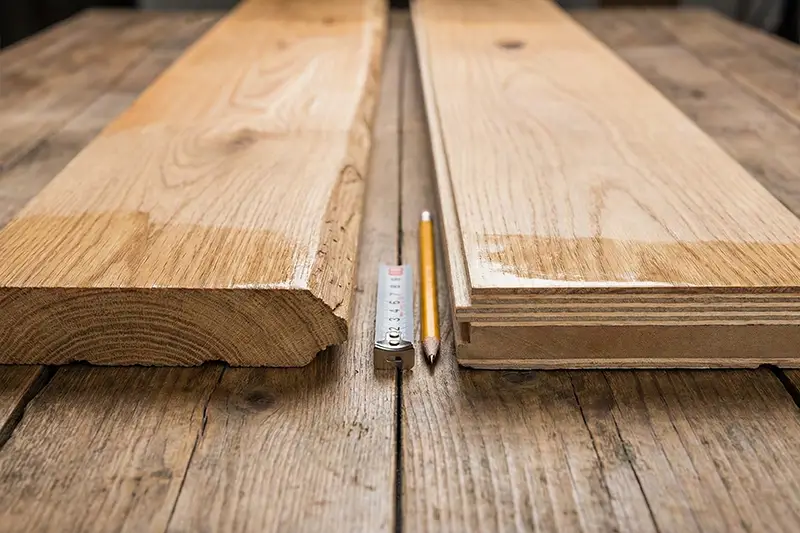
SPC flooring is built as a multi-layer structure: a UV wear layer for scratch resistance, a decorative film replicating wood or stone, a limestone-composite rigid core, and often an acoustic underlay for noise absorption. This construction makes SPC waterproof at the core and highly dimensionally stable — it doesn’t expand or contract significantly with temperature swings, though its thin, rigid profile means it needs a well-leveled subfloor to avoid visible dips or stress on the click-lock joints. You can explore our full SPC flooring range for available dimensions and finishes.
Laminate flooring, by contrast, uses a melamine resin wear layer, a decorative film, and an HDF (high-density fiberboard) core. Wear resistance for laminate is classified under EN 13329, the European standard that defines AC (Abrasion Class) ratings from AC1 through AC6 — not a consumer marketing term, but an actual tested classification worth asking suppliers to document. This construction gives laminate a soft, natural feel and realistic grain, but it remains vulnerable to moisture because the HDF core absorbs water more readily than SPC’s composite core. Newer high-density laminate formulations have narrowed that gap considerably — our MoistureShield 1000 guide covers how far that improvement actually goes, and where its limits still are. For projects in dry, controlled environments, our laminate flooring collection offers a wide range of patterns and wear ratings.
Impact, Scratch & Stain Resistance
SPC’s rigid core and UV coating provide strong resistance to scratches and impacts, making it well suited to commercial spaces with rolling chairs, heavy furniture, or sustained heavy foot traffic. Laminate performs well in residential use, but its top layer can wear faster under abrasive, high-frequency use. Higher AC-rated laminate with aluminum oxide coatings has closed some of that gap, but SPC generally remains the more durable option for heavy-duty commercial applications. For a full breakdown of how to read and verify AC ratings and other wear specifications, see our wear-resistant flooring guide.
SPC vs Laminate Flooring: Water, Heat & Sound Performance
Waterproofing & Temperature Tolerance
This is where SPC clearly outperforms. Its core is fully waterproof, which is why it’s a strong fit for kitchens and other spaces with routine spills and splashing. That said — and this is a distinction worth being precise about rather than glossing over — “waterproof core” does not mean “suitable for every wet space.” SPC is a floating floor installed over an existing subfloor, and that construction method has a real limit: standing water and genuine wet zones, like shower floors, should be specified in ceramic tile instead, regardless of how waterproof the SPC core itself is. Products carrying FloorScore certification have been independently tested for VOC emissions, which is a separate but related indoor air quality consideration worth checking alongside moisture performance. SPC also handles elevated temperatures well without deforming, which is part of why it’s widely used in tropical and humid regions.
Laminate, by contrast, can swell or bubble if exposed to water for extended periods. It’s best kept in dry rooms and protected with proper underlayment and sealed joints where any moisture exposure is possible. For a deeper comparison of waterproof options across all flooring types, see our waterproof flooring guide.
Underlay & Acoustic Performance
Both SPC and laminate can use acoustic underlays for comfort and sound reduction. SPC often integrates IXPE or EVA foam layers to reduce footstep noise. Laminate can feel hollow if installed without padding, though premium laminate collections include built-in underlays. In practice, laminate tends to edge out SPC slightly on sound warmth, while SPC performs better on vibration absorption in commercial settings like retail stores or gyms.
Budget & Installation
Cost Bands & Warranty
Laminate remains one of the more cost-efficient flooring types on a per-area basis, while SPC typically carries a higher upfront cost. SPC generally offers longer manufacturer warranties, which over the life of the floor can offset some of that higher initial price — particularly in commercial settings where replacement and downtime costs matter more than sticker price. For a full cost-per-year comparison across SPC, laminate, engineered wood, and teak, see our flooring lifespan comparison.
Click-Lock vs Glue-Down
SPC flooring is typically installed as a click-lock floating floor, allowing fast installation without adhesives. Laminate uses a similar click system, though both materials expand and contract slightly with humidity changes and need properly sized expansion gaps at the perimeter. Both can go over most existing subfloors, but SPC’s rigidity handles minor subfloor imperfections somewhat better than laminate.
Comparison Table: SPC vs Laminate Summary
| Category | SPC Flooring | Laminate Flooring |
|---|---|---|
| Composition | Stone-plastic composite | Wood-based HDF |
| Waterproof (core) | Yes | No — water-resistant at best |
| Typical Lifespan | 15–20 years | 10–15 years |
| Scratch Resistance | Excellent | Good |
| Comfort Underfoot | Moderate | Softer |
| Suitable for True Wet Zones | No (floating system) | No |
| Best Use | Commercial, moisture-exposed spaces | Residential, dry areas |
Choosing Between SPC and Laminate for Your Project
The right choice usually comes down to two questions: how much moisture exposure will the floor actually see, and how long does it need to perform before replacement is acceptable. For a busy commercial space with regular mopping, spills, or variable humidity — restaurants, retail floors, hotel lobbies — SPC’s waterproof core and longer practical lifespan generally justify the higher upfront cost. For dry residential spaces where underfoot comfort and a lower price point matter more than moisture resistance, laminate remains a sound, cost-effective choice. If you’re weighing a third option — the newer generation of high-density laminate built specifically to narrow the moisture gap with SPC — our MoistureShield 1000 guide walks through exactly where that product fits and where it doesn’t. And if certifications are part of your project’s requirements, our flooring certifications guide explains what to verify before you order either product.
FAQs
Which flooring lasts longer?
SPC typically lasts 15–20 years in normal commercial or residential use, while laminate typically lasts 10–15 years, depending on foot traffic and humidity exposure. Both figures assume correct installation and normal maintenance — neither material performs to these numbers if installed without a proper moisture barrier or expansion gaps.
Can SPC flooring be used in bathrooms?
It depends on which part of the bathroom. SPC handles the general bathroom floor well — splashing, humidity, and routine cleaning are all within its waterproof core’s capability. What it’s not suited for is the shower floor itself or any area with standing water: SPC is a floating system, and water reaching the joints over time will still find its way to the subfloor beneath. For that specific zone, ceramic tile is the correct specification regardless of how waterproof the SPC core is.
Is laminate flooring safe for pets?
Yes, though it scratches more easily than SPC. Choosing a higher AC-rated laminate with a thicker wear layer helps in pet-owning households, and keeping humidity and moisture exposure low matters more for laminate than it does for SPC.
Can SPC and laminate be installed over existing tile?
Both can, in most cases, provided the existing surface is flat and stable. SPC’s rigidity tends to handle minor subfloor irregularities better than laminate, which is more sensitive to an uneven base over time.
Which is easier to repair?
Both allow individual plank replacement thanks to their click-lock systems, so a single damaged plank doesn’t necessarily mean refinishing or replacing the whole floor. Neither material can be sanded and refinished the way solid wood can — once a plank’s surface is worn through, replacement is the only option.
The Bottom Line
SPC and laminate solve different problems well. SPC’s waterproof core, dimensional stability, and longer practical lifespan make it the stronger choice for moisture-exposed commercial spaces and humid climates — just not for genuine wet zones like shower floors, where tile remains the right call regardless of core waterproofness. Laminate costs less, feels warmer underfoot, and performs reliably in dry residential spaces where that trade-off makes sense. If you’re still weighing the decision for a specific project, we’re happy to talk through the actual conditions the floor will see — that’s usually more useful than a generic recommendation either way.