
Why I’m Rewriting What Flooring Recycling Means
For years, flooring companies, mine included, have talked about flooring recycling as if it were one simple promise: buy this product, and at the end of its life it gets recycled into something new. I no longer think that promise is honest, at least not for the materials most of us actually sell. After three decades sourcing and distributing flooring, and after being pushed on this question by a buyer who correctly pointed out that our own products don’t get collected by any municipal recycling service, I want to separate two things that constantly get blurred together in this conversation.
The first is recycled content: using someone else’s waste as the raw material input for a new product. The second is end-of-life recyclability: whether the product itself, once it has reached the end of its working life, can realistically be collected, reprocessed and turned into something new. These are not the same claim, and a product can satisfy one without coming anywhere close to the other. Most sustainability marketing in this industry, across the board and not just at Karlyn Floors, leans on the first claim to imply the second, because “recycled” sounds better in a brochure than “made partly from recovered material, but not itself recoverable.” This article is my attempt to separate them honestly, using our own SPC and ResinCore lines as the test case, and to be specific about which claim each material can actually support.
The Hard Truth About End-of-Life Flooring Recycling
Why Reverse Logistics Breaks Down
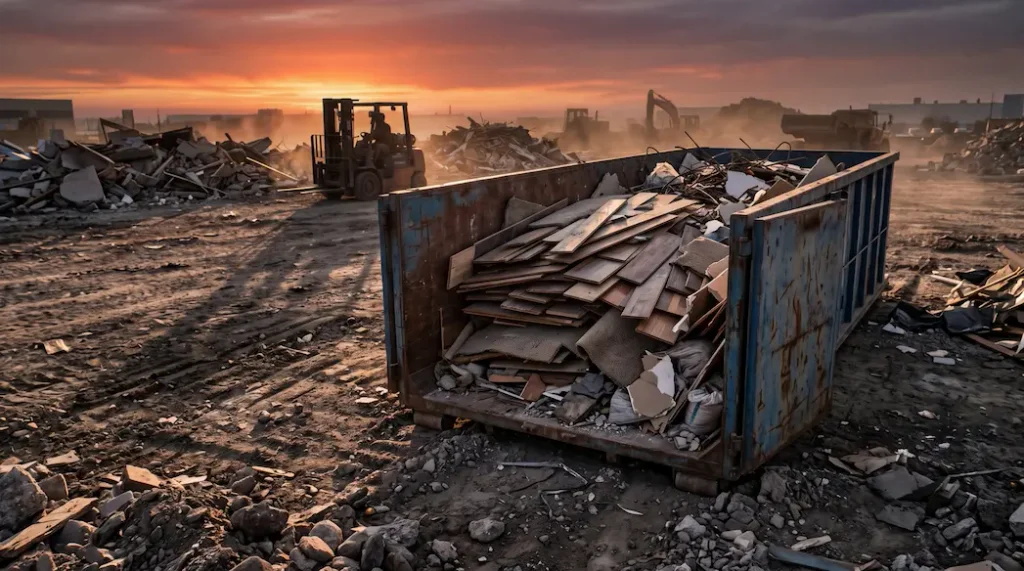
Flooring is bulky and heavy. It’s also installed across thousands of individual locations, not concentrated in one place. Reprocessing it means someone has to demolish it, sort it from other construction waste, and transport it. All of that has to happen cheaply enough that reprocessing still pays off. Take a product made in Asia and shipped to a buyer in Germany. Getting that material back to the factory at any meaningful scale isn’t realistic, and this isn’t a Karlyn-specific failure either. Europe’s own vinyl industry body has spent over two decades building collection infrastructure for exactly this reason.
VinylPlus, which started in 2010, has recycled more than four million tonnes of PVC across the wider building and construction sector since then. That number sounds large until you remember it spans windows, pipes, cables and flooring combined. It still draws mostly from production offcuts, not material pulled out of finished buildings years later.
What Happens to Thermoset Materials Like ResinCore
There’s a second, more fundamental barrier specific to ResinCore. Its core is built from epoxy resin, which is a thermoset material. Thermoset plastics cure through an irreversible chemical reaction that creates permanent molecular cross-links. Once cured, they cannot be melted down and reshaped the way thermoplastics like PVC can. As one construction-industry reference puts it plainly, thermosets “cannot be melted back down, they just burn or char, so cannot be reshaped or restored to their original properties”. That means claiming high end-of-life recyclability for ResinCore isn’t just optimistic, it conflicts with the basic chemistry of the material. I’d rather say that plainly than have a buyer with a materials science background catch the contradiction themselves.
The Economics Work Against Recycled Input
Even where end-of-life collection exists, as it does for some PVC flooring through schemes like the UK’s Recofloor, the volumes stay modest; Recofloor reports roughly six thousand tonnes diverted since 2009, a fraction of the flooring installed over that period. Reprocessed material also typically costs more per unit than sourcing virgin input, since collection, sorting and cleaning all add cost that buying new material avoids. We’ve heard this directly from the market: a German importer who asked us about a recycled-content product told us plainly that the economics still favor virgin material in most cases. Until collection infrastructure matures or regulation changes the cost calculus, that’s the honest state of flooring recycling economics, not a Karlyn-specific limitation.
ResinCore and Flooring Recycling: Reuse, Not Recycling
From PCB Offcuts to Flooring Core
Where ResinCore genuinely earns a sustainability claim is on the input side. Its core material is built from pre-laminated panel offcuts that would otherwise never become printed circuit boards, an e-waste-adjacent stream that ground into powder and bonded with MDI glue becomes a dense, stable flooring core. That is a real instance of using someone else’s manufacturing waste instead of extracting new raw material, and it does not depend on ResinCore ever being collected and reprocessed again at the end of its life. You can read the full material story on our ResinCore explainer, and current formats are on the ResinCore product page.
Why This Still Counts as Circular Design
The EU’s own circular economy framework doesn’t actually require a product to be recyclable at end of life to count as a circular design choice. The European Commission’s Circular Economy Action Plan addresses recycled content and end-of-life material recovery as distinct policy levers within the same framework, not a single bundled claim. ResinCore sits on the recycled-content side of that framework, and it sits there comfortably: the input material is verifiably recovered rather than virgin, the manufacturing process diverts waste that would otherwise go to landfill or incineration, and none of that depends on a future promise we can’t yet keep. I’d rather make that specific, defensible claim than stretch it into a promise about reprocessing the finished plank, which the material itself can’t support.
SPC and Flooring Recycling: Why Lifespan Matters More
Virgin PVC and Dimensional Stability
Our SPC is manufactured from virgin PVC, not reprocessed material, and that’s a deliberate choice rather than an oversight. Virgin PVC gives the core consistent density and dimensional stability, which is what lets SPC resist warping under humidity swings and temperature changes across the climates we ship to. Using reprocessed PVC, where supply is inconsistent in composition, would compromise that stability. So unlike ResinCore, SPC’s sustainability story was never going to be about recycled input in the first place.
Longevity as a Circularity Strategy
What SPC can honestly claim is longevity. A floor that lasts 15 to 25 years with proper care, as detailed in our flooring lifespan comparison, gets replaced less often than shorter-lived alternatives, which means fewer manufacturing cycles, less transport, and less material entering the waste stream over a building’s lifetime. That’s a legitimate circularity argument even without end-of-life recyclability attached to it; it just needs to be framed as what it is, a lifespan argument, not a recycling one.
| Material | Recycled Content (Input) | End-of-Life Recyclability (Output) | Honest Circularity Claim |
|---|---|---|---|
| ResinCore | Yes — built from recovered PCB laminate offcuts | No — thermoset epoxy core cannot be remelted | Reuse of e-waste-adjacent material as input |
| SPC (Karlyn) | No — manufactured from virgin PVC for stability | Limited — PVC is thermoplastic, but collection logistics make reprocessing uneconomical at scale | Extended lifespan reduces replacement frequency |
Where EU Policy Is Pushing Flooring Recycling Next

Construction Products Regulation and EPD Requirements
None of this means end-of-life recycling for flooring is a dead end, only that it’s further off than marketing copy usually admits. The regulatory direction is real and worth tracking closely if you specify or import flooring into Europe. The revised EU Construction Products Regulation (EU) 2024/3110 entered into force in January 2025, and its environmental performance declaration requirements, built on the EN 15804 life-cycle assessment standard, begin applying to construction products from January 2026 onward. An Environmental Product Declaration under ISO 14025 is a standardized, independently verified report of a product’s life-cycle environmental performance, not a recyclability certificate, and it’s becoming close to table stakes for anyone selling into EU public procurement or green-certified projects. We don’t hold EPD certification for our lines today, but as EN 15804-based declarations become the accepted baseline across the industry, it’s a direction we’re actively working toward rather than claiming prematurely. For the wider picture of how ESG pressure is changing the way buildings get specified, see our article on ESG flooring.
Waste Framework Directive and Flooring-Specific Research
The EU’s broader Waste Framework Directive requires Member States to establish sorting systems for construction and demolition waste and sets recovery targets for it, pushing toward better sorting infrastructure at the point of demolition, which is the actual bottleneck for recovering flooring at end of life, not manufacturer willingness. Flooring-specific EU research, including the Horizon 2020-funded CISUFLO project, which focused specifically on wood, vinyl and textile flooring recyclability, is working on exactly the separation and sorting technology that would need to exist before SPC-style flooring could be collected and reprocessed at scale. Progress here depends on policy and infrastructure outside any single manufacturer’s control, which is why I’d rather point you to the real research than promise a timeline we don’t control.
| Framework | Focus | Relevance to Flooring Recycling |
|---|---|---|
| EU Circular Economy Action Plan | Recycled content targets and end-of-life recovery, treated separately | Supports input-side claims like ResinCore’s recovered material |
| Construction Products Regulation (EU) 2024/3110 | Mandatory environmental performance declarations from 2026 | Pushes EPD adoption across construction material suppliers |
| Waste Framework Directive | Construction and demolition waste sorting standards | Addresses the collection bottleneck, not manufacturer design |
| CISUFLO (Horizon 2020) | Flooring-specific recyclability research | Developing the separation technology end-of-life recycling needs |
What Buyers Are Actually Asking For
We’re already seeing demand-side interest in the flooring recycling conversation, not just regulatory pressure. European importers have asked us directly for something new to offer their own customers around sustainability, and ResinCore’s recovered-material story has been a genuine point of interest in those conversations. Several of these inquiries have come from buyers who specifically wanted a product angle their competitors weren’t offering yet, which tells me this is partly a differentiation play as much as a compliance one.
But I’d be overstating it to call this a settled trend. The same buyers who ask about recycled content also do the math on cost, and reprocessed or recovered-material inputs still tend to land above virgin material pricing in the quotes we’ve put together. One recent inquiry from a German importer went exactly this way: genuine interest in the sustainability story, a quotation that reflected the real cost of recovered material, and then no follow-up once the number landed on their desk. That gap between interest and purchase is where the real friction sits right now, more than in any lack of awareness. It tells me the market is curious and actively testing the waters, not yet voting with volume, and I’d rather report that honestly than claim demand we haven’t actually converted.
Flooring Recycling Certifications vs Real Market Access
There’s a limit to how much a sustainability story, however honest, actually moves a purchasing decision. Certifications and declarations answer the question “is this product’s environmental claim real,” but they don’t answer a separate question that sits upstream of it: can this product reach the market competitively in the first place. A well-documented EPD or a verified recycled-content claim doesn’t offset a cost disadvantage created by tariffs, trade measures, or market access barriers that have nothing to do with the product’s sustainability credentials.
That’s worth naming plainly, because it’s easy for sustainability content to imply that credentials alone drive purchasing decisions, when in practice they’re one factor among several that include price, lead time, and whether the product can be landed in the destination market on competitive terms at all. We’d rather be clear about that boundary than let a circularity story stand in for the full picture a buyer actually needs to evaluate a sourcing decision, and we’d rather flag that gap honestly than have a client discover it later in a quote.
Frequently Asked Questions
Is SPC flooring recyclable?
Chemically, PVC is a thermoplastic and can theoretically be reprocessed. In practice, collecting installed SPC flooring from a building, sorting it from other waste, and transporting it back to a facility capable of reprocessing it rarely makes economic sense today, especially for material exported internationally. Our SPC’s environmental case rests on its 15 to 25 year lifespan rather than a recycling claim we can’t back up logistically.
Can ResinCore be recycled at the end of its life?
No, not in the way “recyclable” usually implies. ResinCore’s epoxy resin core is a thermoset material, and thermosets cannot be melted down and reshaped once cured. ResinCore’s genuine sustainability story is on the input side: it’s made from recovered PCB laminate offcuts that would otherwise go to waste, not from a promise that the finished plank gets reprocessed later.
What’s the difference between recycled content and recyclability?
Recycled content describes what a product is made from, specifically whether it uses reclaimed or recovered material as a raw input. Recyclability describes what happens to the product after its useful life ends, whether it can be collected and reprocessed into something new. A product can have excellent recycled content and poor end-of-life recyclability, or the reverse. Flooring recycling claims should specify which one they mean.
Why doesn’t flooring get picked up by municipal recycling?
Municipal recycling programs are built around common household materials collected in high, consistent volumes, like glass, paper, and certain plastics. Flooring is bulky, comes from demolition rather than household waste streams, and requires specialized sorting and reprocessing that most municipal systems aren’t equipped for. Collection generally has to happen through manufacturer take-back schemes or specialized construction waste recyclers instead.
Will flooring recycling get easier in the next few years?
Some of the groundwork is being laid. EU regulation is pushing environmental performance declarations and better construction waste sorting, and flooring-specific research like the CISUFLO project is working on the separation technology that end-of-life recycling depends on. None of that changes the economics or logistics overnight, so I’d treat near-term progress as incremental rather than expect a fast shift to a fully circular supply chain.
Conclusion: A Circular Flooring Story We Can Actually Defend
I’d rather tell you a smaller, true story than a bigger one that falls apart under a buyer’s first follow-up question. ResinCore earns its sustainability claim honestly, through recovered material used as input, not through a promise about what happens to it decades from now. SPC earns its claim through durability and lifespan, not through recyclability it was never designed around. Neither of those is as tidy as “this floor gets recycled,” but both are defensible, and defensible is what actually matters when you’re specifying material for a client who will ask hard questions.
The industry’s flooring recycling story will keep improving as EU regulation tightens and sorting infrastructure matures, and we’ll keep tracking that progress rather than getting ahead of it. In the meantime, if you’re weighing circularity claims from any supplier, not just us, ask specifically whether they mean recycled content or end-of-life recyclability, and ask for the certification or data behind whichever one they’re claiming. If you want to talk through where SPC or ResinCore genuinely fits your project’s sustainability goals, reach out to our team and we’ll walk through what each material can and can’t honestly promise.