Why I Kept Turning Clients Away From Real Parquet
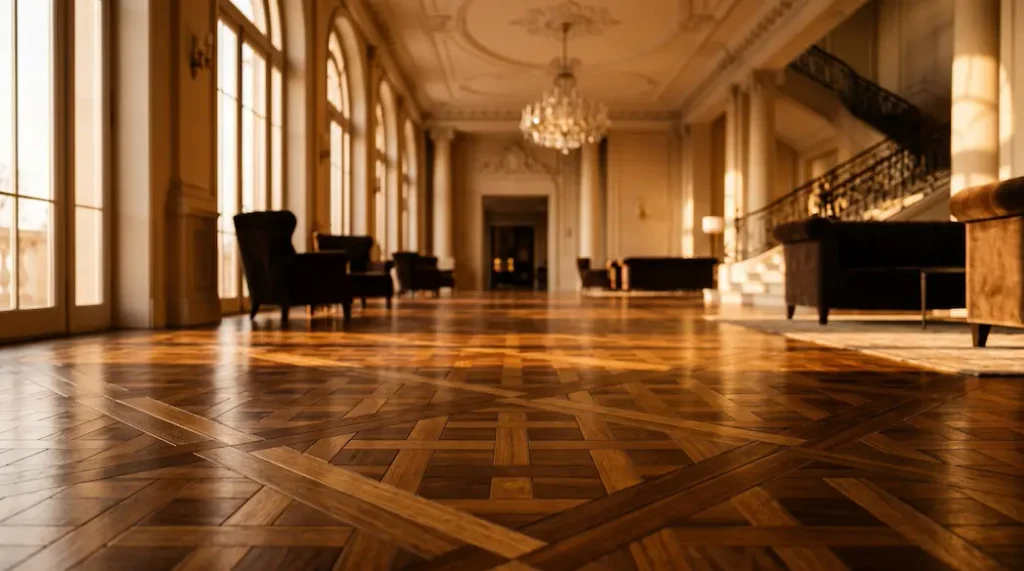
For years, every time a hotel designer or a luxury residential client asked me for parquet, I had the same uncomfortable conversation. Solid wood parquet looks extraordinary. It also hates water, takes skilled labor to install correctly, and needs refinishing within a decade in any space with real foot traffic. For a boutique hotel lobby or a high-traffic residential project, that combination is a liability, not a feature. I spent a long time telling clients “yes, but” before I could recommend it. SPC parquet flooring changes that conversation, and I want to walk through why, using our own EIR Parquet SPC Collection as the example.
Where Parquet Came From
Parquet itself has a specific history worth knowing before you specify it. The pattern dates to 1684 at the Palace of Versailles, where large diagonal squares known as parquet de Versailles replaced marble flooring that required constant washing and tended to rot the floor joists beneath it. Herringbone and chevron variations followed in the 18th century as the pattern spread across Europe. Even the word hints at the idea: parquet comes from the Old French parchet, meaning a small compartment or enclosed space, which fits a floor built from many small pieces fitted into one larger geometry.
That history matters here because it reframes the question: parquet was never really about wood for its own sake. It was about a geometric pattern that photographs and feels prestigious. The material underneath has always been negotiable, and it has already changed once before. Engineered wood parquet, a thin layer of real hardwood over a stable plywood core, solved some of solid parquet’s stability problems decades ago without abandoning real wood entirely. SPC is simply the next material in that same line of succession, and arguably a more honest one: it doesn’t pretend to be solid wood, it just borrows the geometry that made the pattern desirable in the first place.
What SPC Parquet Flooring Actually Solves
The Moisture Problem
Solid parquet blocks are small, individually fitted pieces of wood, which means more seams and more edges exposed to moisture than a standard plank floor. A spill near an entrance or a kitchen pass-through can swell individual blocks unevenly, and once that happens, the repair is disruptive and visible. Our SPC core is fully waterproof, so the pattern holds its shape regardless of what happens on the surface. For hospitality projects where a lobby floor sees spilled drinks, wet umbrellas, and tracked-in rain on a daily basis, this single property removes an entire category of maintenance calls. If you’re also weighing laminate for a budget-sensitive part of the same project, our SPC vs laminate comparison explains where water resistance and true waterproofing diverge.
The Refinishing Ceiling
Solid wood parquet can be sanded and refinished, but only a limited number of times before the wood is too thin to sand again, and each refinishing cycle takes the space out of service. This collection doesn’t offer refinishing, but it doesn’t need it in the same way: the wear layer is engineered to resist scratching and fading for the life of the floor rather than being periodically restored. For an investor comparing lifecycle cost rather than romantic appeal, that’s a simpler maintenance model, even if it’s a different one.
The Installation Skill Gap
Traditional parquet installation requires a skilled tradesperson cutting and fitting individual wood blocks on site, piece by piece. That labor is increasingly hard to find and expensive where it exists. Our EIR Parquet SPC Collection installs with a 5G click-lock system instead. 5G fold-down locking technology uses a flexible insert that snaps into place as each panel is folded down, creating a leakproof, mechanically locked joint without glue or specialized tools. The parquet pattern is pre-formed into each 600×600mm tile at the factory, so installers are locking tiles into place rather than hand-fitting individual wood pieces.
That shift matters more than it sounds: it moves the skill requirement from the job site, where quality varies installer to installer, to the factory, where it’s consistent across every tile in the order. For a multi-room hotel project or a developer fitting out dozens of units, that consistency is worth more than it might seem on a single-room job, since it removes one more variable from a project timeline that’s usually already tight.
The Technology Behind SPC Parquet Flooring: What EIR Actually Means
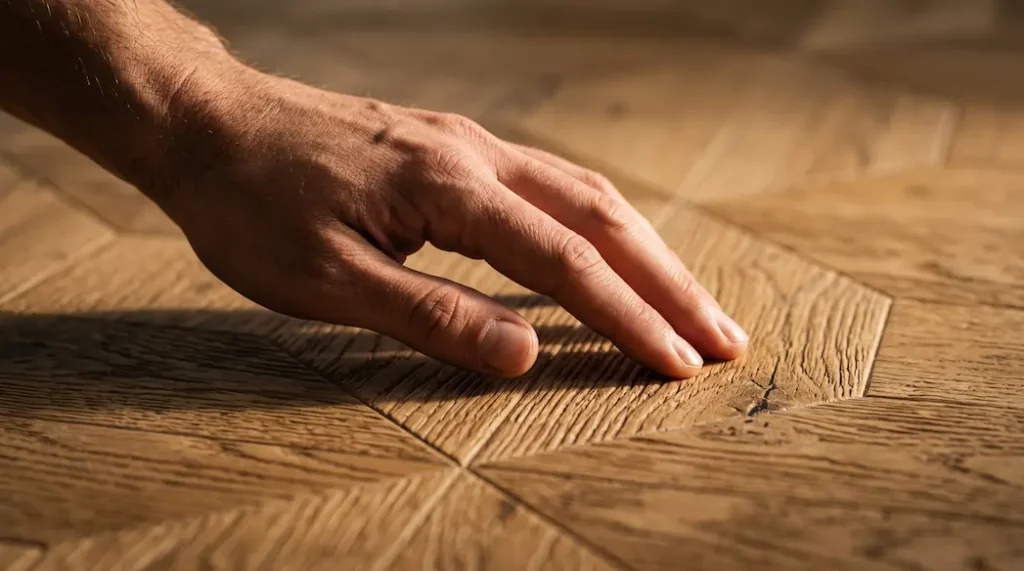
EIR stands for Embossed in Register, and it’s the detail that separates a convincing SPC parquet floor from an obviously fake one. On a standard embossed vinyl floor, the printed wood-grain image and the physical texture pressed into the surface don’t line up, so your fingers feel ridges in different places than your eyes see grain lines. EIR works by marking the edge of the printed decor with register marks, so the press plate lines up precisely with the printed image. The pores and grain of the wood end up in the same place you see them in the print, and the grain you see is the grain you feel.
That article describes laminate decor paper, whereas our SPC uses a printed film, but the registration principle is the same. It also makes clear why this is hard to do well: it takes close cooperation across the whole production chain, from decor printing to press plate making, which is part of why EIR took years to reach the market.
Why EIR Is a Choice, Not a Default
EIR is also a choice rather than a default. Manufacturers keep several kinds of texture plates, including smooth, hand-scraped, wire-brushed and EIR plates, and pick among them based on the image they are trying to reproduce. For a parquet pattern, I would always specify EIR. The first commercial EIR surfaces were tile effects, where the whole challenge was getting the grout lines to line up with the embossing, and the block joints in parquet pose exactly the same challenge. If the texture drifts away from the joints, the pattern reads as a printed picture of parquet rather than a floor.
| Attribute | Solid Wood Parquet | EIR Parquet SPC Collection |
|---|---|---|
| Moisture resistance | Vulnerable; blocks can swell or cup | Fully waterproof core |
| Installation | Skilled trade labor, block by block | 5G click-lock, no glue required |
| Refinishing | Possible, limited number of cycles | Not refinishable; engineered wear layer instead |
| Pattern consistency | Depends on installer skill | Pre-formed pattern, factory consistent |
| Underfloor heating | Often restricted or requires special detailing | Compatible |
Two SPC Parquet Flooring Pattern Families for Different Jobs
HR8289 Woven Basket
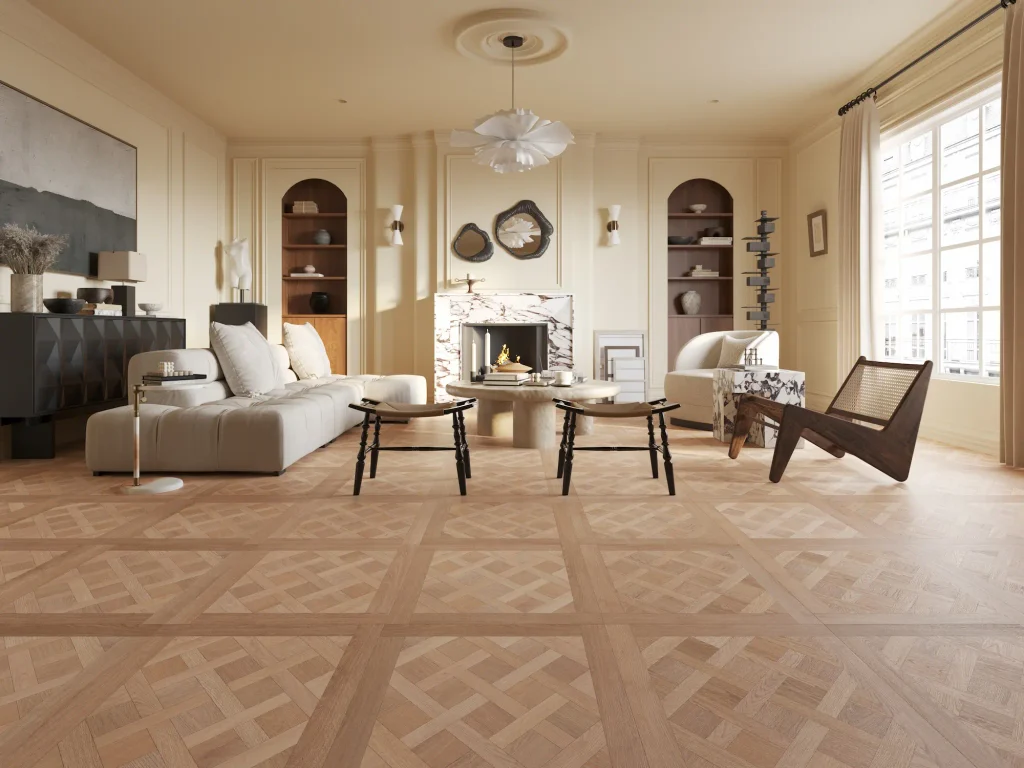
This is the quieter of the two patterns, built on the basket weave structure that has anchored parquet design since its earliest French interiors. It reads as classic rather than trend-driven, which is exactly why it suits luxury residential projects and boutique hospitality interiors where the floor needs to support the room rather than compete with it. I’d specify this where the client wants permanence over statement.
HR8292 Star Pinwheel
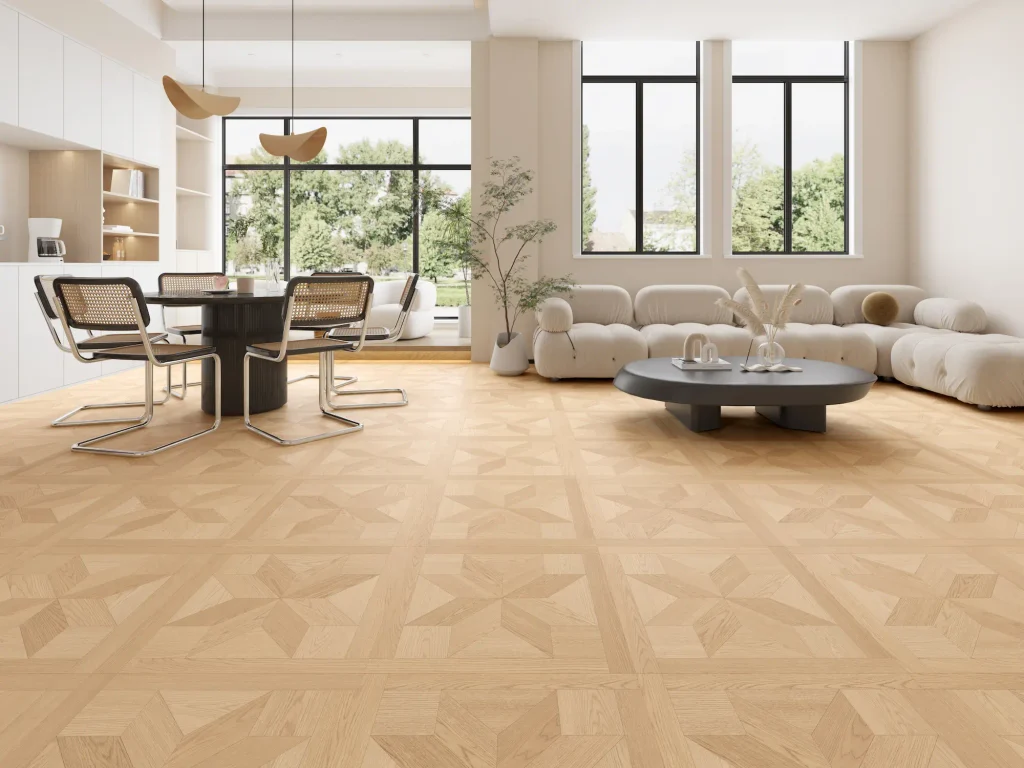
This pattern pulls from the more geometric, star-based parquet traditions and reads as considerably bolder in person. It’s the one I’d put in a hotel lobby or a feature area that needs to announce itself the moment someone walks in. Scale matters here: this pattern rewards a large, open floor plate where the repeat can actually read as a pattern rather than getting cut off awkwardly at the edges of a small room.
Both pattern families come in seven colorways each, for fourteen total, in a single 600×600mm format with a 5mm minimum thickness. Wear layer is specified at either 0.3mm or 0.5mm depending on project requirements, which follows the same logic we use across our other SPC lines: 0.3mm for standard residential use, 0.5mm where the floor will see heavier commercial traffic. I’d default to 0.5mm for any hospitality project without a second thought, since the cost difference per square meter is small relative to the cost of a lobby floor that starts showing scuff marks within a year of opening.
Minimum order quantity is 500 square meters, which is standard for a collection launch rather than a reflection of production difficulty. The collection debuted at a major flooring trade show in Shanghai earlier this year, and at the time of writing we’re taking orders for delivery in the second half of 2026, so timeline planning matters if you’re specifying this for a project with a fixed opening date.
| Specification | Detail |
|---|---|
| Format | 600 × 600 mm |
| Thickness | From 5 mm |
| Wear layer | 0.3 mm (residential) or 0.5 mm (commercial), to specification |
| Surface | EIR — Embossed in Register |
| Installation | 5G click system with insert |
| Patterns | HR8289 Woven Basket, HR8292 Star Pinwheel |
| Colorways | 14 total (7 per pattern series) |
| Minimum order quantity | 500 m² |
Where I’d Specify SPC Parquet Flooring, and Where I Wouldn’t
Hotels and boutique hospitality are the clearest fit. Lobbies and feature areas get heavy, varied foot traffic (luggage wheels, wet shoes, spilled drinks) that would punish solid parquet over a few years, while still wanting the visual weight that parquet patterns deliver. High-traffic residential works the same way: open-plan living areas and entryways in family homes see more abuse than a formal dining room ever would. Retail environments with a boutique or heritage positioning are a third fit, where the pattern does brand work that a plain plank floor can’t.
Where I’d pump the brakes: a project where the client specifically wants the patina and irregularity of genuinely aged solid wood, since no printed surface fully replicates decades of real wear, however good the EIR alignment is. If the brief explicitly calls for reclaimed or antique parquet character, that’s a conversation about solid wood, not about this collection pretending to be something it isn’t.
For very small rooms, I’d lean toward the Woven Basket pattern over Star Pinwheel, since a bold geometric repeat needs floor area to actually resolve as a pattern rather than looking chopped off at the walls. I’d also think carefully before specifying Star Pinwheel in a room with a lot of competing pattern already in play, furniture, rugs, a busy ceiling design, since the point of a statement floor is to be the statement, not one voice in a crowded room. A quieter pattern paired with bolder furnishings usually photographs and lives better than two bold elements fighting for attention.
Frequently Asked Questions
Is SPC parquet flooring as durable as solid wood parquet?
It’s durable in a different way. Solid wood can be refinished to extend its life, but it’s also vulnerable to moisture damage and wears unevenly at seams between blocks. This collection doesn’t refinish, but its waterproof core and engineered wear layer mean it doesn’t need to: it’s built to hold its appearance for the life of the floor rather than being restored partway through.
Can SPC parquet flooring be installed over existing flooring?
In most cases, yes, provided the existing subfloor is flat, stable, and clean, which is standard for click-lock SPC installation generally. Project-specific subfloor conditions should always be confirmed before ordering, since an uneven substrate will telegraph through any rigid click-lock floor over time.
What’s the difference between the Woven Basket and Star Pinwheel patterns?
Woven Basket (HR8289) is a classic basket-weave block pattern that reads as timeless and understated, suited to luxury residential and boutique hospitality interiors. Star Pinwheel (HR8292) is a bolder geometric star pattern designed to make a stronger visual statement, better suited to lobbies and feature areas with enough open floor space for the pattern to read clearly.
Does SPC parquet flooring work with underfloor heating?
Yes, the collection is compatible with underfloor heating systems, which is one of its practical advantages over solid wood parquet, where heating compatibility often requires special detailing or is restricted altogether depending on the wood species and construction.
What is EIR and why does it matter for a parquet pattern specifically?
EIR (Embossed in Register) aligns the physical texture pressed into the floor’s surface with the printed wood-grain pattern beneath it, so the grain you feel matches the grain you see. For a parquet pattern, this matters more than on a standard plank because the geometric block joints need to feel physically real underfoot, not just look correct from a distance.
Requesting Samples
The EIR Parquet SPC Collection debuted at a major flooring trade show in Shanghai earlier this year, and we’re currently accepting orders for the second half of 2026. Minimum order quantity is 500 square meters, and we typically respond to sample and catalogue requests within one business day.
If you’re weighing this collection against a solid wood alternative for a specific project, reach out to our team and we’ll help you work through which pattern and wear layer spec fits your traffic conditions. You can also see how SPC performs more broadly in our waterproof flooring guide, or check how long a well-specified SPC floor should actually last in our flooring lifespan comparison. Either way, bring us your floor plan and traffic profile and we’ll tell you honestly whether Woven Basket, Star Pinwheel, or a plainer plank format is the better fit, rather than just selling you the newest collection in the catalogue.