Why Pet Friendly Flooring Is Not One Material
Have you ever stopped to consider that a household with a dog or a cat needs a genuinely different floor specification from one without? Not a different colour or a different budget tier, but different mechanical requirements: abrasion resistance, a waterproof core, usable traction and a surface that cleans without special products. In more than thirty years of distributing flooring, I have watched this distinction get flattened into a single marketing phrase, pet friendly flooring, as if one material property could answer four separate problems at once. It cannot, and treating it as though it can is how specifications fail after move-in rather than before it.
The scale of the issue is not small. The AVMA reported that 38.4 percent of US households own dogs and 25.4 percent own cats, with 56.8 percent of households owning some type of pet, and APPA’s 2025 State of the Industry Report found that 94 million US households, or roughly 71 percent, now own at least one pet, with 51 percent owning a dog and 37 percent owning a cat. In Europe, FEDIAF’s most recent Facts & Figures report found that 139 million households, or 49 percent, now share their home with a pet. Those are the end users behind your orders: tenants, homeowners and hotel guests who arrive with animals whether the specification sheet expected them or not.
This article is written for the people who specify and buy, meaning designers, developers, property managers and flooring retailers. It is not a consumer shopping list. I will tell you which of our materials I recommend, which I deliberately leave out, and where every claim in this category, including ours, reaches its limit.
What Pets Actually Do to Your Flooring
Before choosing a material, I separate the three ways animals stress a floor, because each one points to a different specification response.
Claws and Abrasion
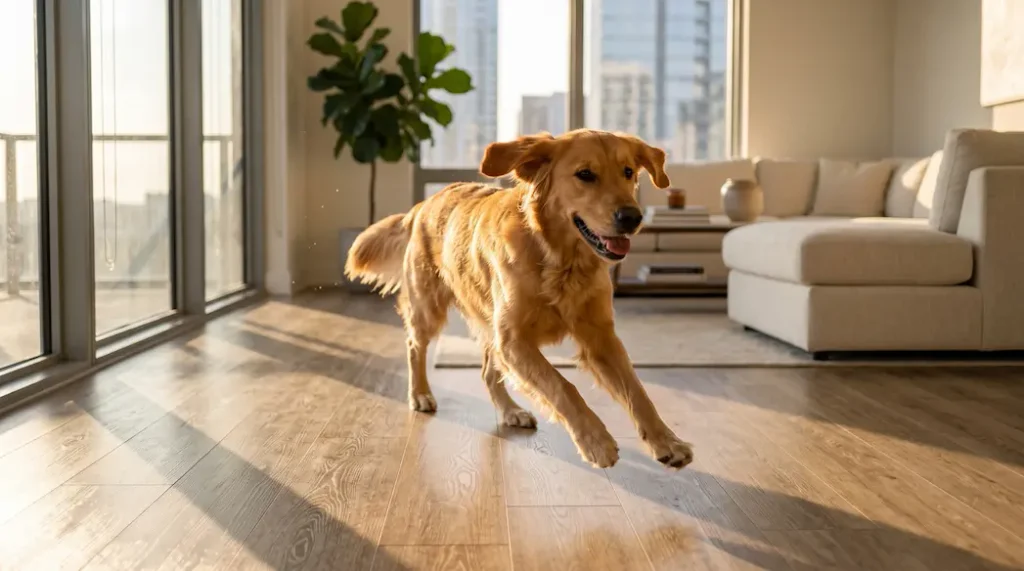
A running dog is a set of small, sharp tools applied at speed. Claws leave fine scratches and, on glossier finishes, visible dulling along the routes animals use most: hallways, thresholds and the path to the food bowl. The wear layer, the transparent film above the printed decor, is the first line of defence. Thickness matters, but so does the finish. A matte, lightly embossed surface hides micro-scratches far better than a high-gloss one, which shows every mark under raking light. I have watched sound floors get rejected because a gloss that photographed beautifully aged badly.
Liquids, Accidents, and What Waterproof Really Means
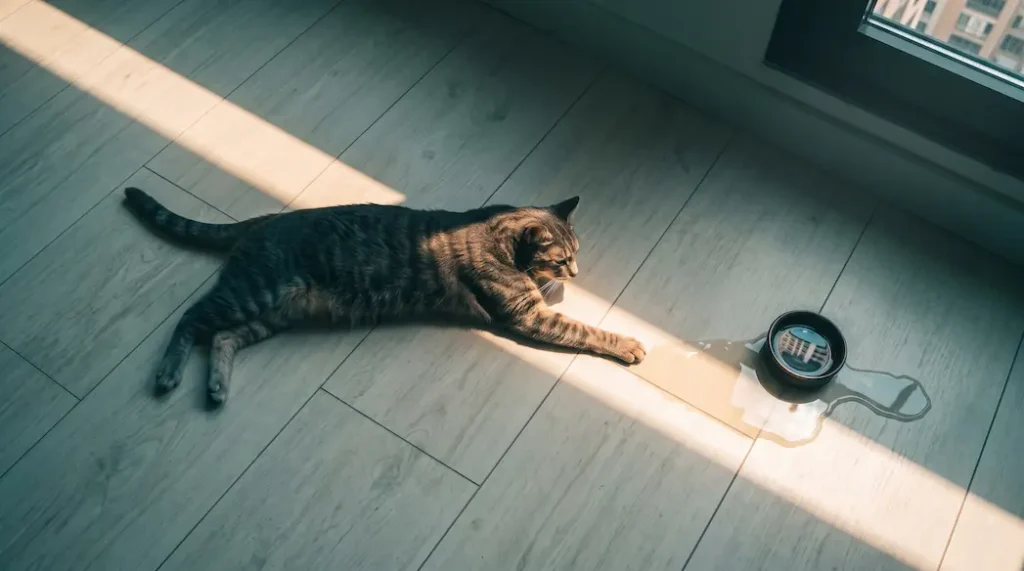
Water bowls tip, puppies have accidents and wet paws come in from the rain. This is where the difference between water resistant and waterproof stops being marketing vocabulary. A waterproof core, such as SPC or ResinCore, does not swell when liquid reaches it. A water resistant laminate core tolerates a quickly wiped spill but can swell if liquid sits in a joint. The surface is not the only question either: liquid that travels through a click joint can sit on the subfloor for weeks and create odor and hygiene problems while the plank itself looks untouched. I return to this in the risk section below.
Traction and Joint Stress
Dogs accelerate, turn and stop on floors in ways people never do. Very smooth, glossy surfaces give poor traction, and older or larger animals struggle to get up from them. A slightly textured surface improves grip but also holds more dirt, so this is a trade-off rather than a free lunch. Repeated impact at doorways also tests the locking system, which is why I ask about joint strength and not only surface performance. Getting this balance right is really the core of specifying pet friendly flooring correctly.
Pet Friendly Flooring Criteria That Matter in Specification
When a client says the floor must suit animals, I translate that into measurable checks. These are the questions I put in front of a buyer before we discuss price. None of them is exotic, yet I regularly see quotations that answer none of them.
The Checklist Before You Quote
| Criterion | Why it matters with animals | What to verify before ordering |
|---|---|---|
| Wear layer thickness | Claws and grit abrade the surface first | Thickness in mm and the test method behind any abrasion claim |
| Core waterproofing | Accidents and wet paws reach the core | Whether the core is waterproof or only water resistant |
| Surface finish | Gloss shows scratches; texture affects grip | Matte or low-gloss finish, approved under raking light |
| Joint system | Liquid can enter at joints and edges | Locking type, tolerance and recommended perimeter treatment |
| Underlayment | Nails and impact create noise and hardness | Attached or separate acoustic underlay and its compatibility |
| Indoor air quality | Animals and people share the same air near the floor | Emission certification such as FloorScore, which is recognised by LEED v4.1, WELL and BREEAM |
| Repairability | Damaged planks are inevitable over time | Spare cartons from the same batch and replacement method |
The wear layer deserves a specific comment. In SPC, I treat 0.3 mm as the floor for light residential use and 0.5 mm as my working minimum for households with large or multiple dogs. For laminate, the industry shorthand is the AC rating under EN 13329, which runs from AC1 to AC5 based on sandpaper abrasion cycles. The North American Laminate Flooring Association notes that AC rating measures abrasion resistance alone, not impact or stain resistance, so I never treat it as the whole story. For a pet household I ask for AC4 or higher and still expect visible wear within a few years on main routes. Our guide to wear-resistant flooring goes deeper on how to read those specifications.
Pet Friendly Flooring Material by Material
Here is where I land on pet friendly flooring, product by product. I have left out solid teak and engineered wood on purpose. I sell both and admire both, but a natural wood surface will dent and scratch under claws, and a veneer top layer cannot be refinished many times. Recommending either for a home with large or active dogs would sell the client a maintenance plan they never asked for.
SPC: My Default Pet Friendly Flooring Recommendation
I reach for SPC first in almost every brief like this. The stone plastic composite core is fully waterproof and dimensionally stable, so it stays flat and unaffected by temperature or humidity swings, and it is rigid enough to resist denting from paws and furniture. Our SPC range carries ISO 9001, CE and FloorScore certification, and click installation suits renovation schedules without disrupting an occupied unit. Its weaknesses are honest ones. The surface feels hard underfoot, and nail noise travels more than on softer floors, so I specify an acoustic underlay in any upper-floor unit. Our waterproof flooring guide explains the moisture mechanics in more detail, and current formats are listed on the SPC flooring page.
ResinCore: The Premium Waterproof Option
ResinCore is what I bring out when a client wants waterproof performance with a stronger sustainability story attached. The core is built from epoxy resin recovered from pre-laminated panel offcuts that never became circuit boards, ground to powder and bonded with MDI glue. I specify it as waterproof, formaldehyde-free and fire-retardant to A2-s1, with the dimensional stability that comes from a dense, engineered core. It costs more than SPC, has a shorter track record in the field, and production takes roughly 35 to 40 days, so I use it for planned projects rather than urgent restocking. The full story is in our ResinCore explainer, and specifications sit on the ResinCore page.
Laminate and MoistureShield 1000: Budget Options With Honest Limits
Standard laminate pairs a high-density fiberboard core with a scratch and stain resistant surface layer, and I tell clients plainly that it is water resistant, not waterproof. It suits dry rooms with light or occasional animal use, and it cannot be refinished once damaged. MoistureShield 1000 improves on that baseline with a 1000 kg/m³ HDF core, against roughly 600 to 800 kg/m³ for ordinary laminate, which measurably improves stability in humid or variable conditions. I still would not put either in a kitchen, an entrance, or any room where a puppy is being trained, because the core itself is not built for standing liquid. I position both as budget options on the laminate flooring page, never as the first choice for a genuinely wet-prone space.
Specifying Pet Friendly Flooring by Property Type
The pet friendly flooring conversation changes with the building, so I split my advice by property type rather than by material alone.
Rental Portfolios and Build-to-Rent Developments
Landlords who allow animals need floors that survive turnover without a full replacement. SPC across the whole unit gives one material, one cleaning routine and simple spare stock. Buy extra cartons from the same production batch for repairs, since a colour lot mismatch years later is a common and avoidable headache. Our guide to flooring for rental properties covers the landlord economics in more depth.
Veterinary Clinics, Grooming Salons, and Boarding Facilities
These are the most demanding animal environments: constant wet cleaning, frequent disinfectant use and stressed animals that are prone to accidents. Waterproof SPC or ResinCore are the sensible candidates. Ask for test data on the specific cleaning agents you use, because disinfectant compatibility is not something I will guess at. Plan wall and drain perimeters carefully as well, since the plank itself is rarely where water gets in.
Hotels and Serviced Apartments That Welcome Animals
Hospitality is where pet policy meets guest perception. Guests without animals do not want to smell them, and turnaround time is short. Waterproof planks that clean thoroughly, with a matte surface that does not advertise scratches, are the right base. Our hotel flooring guide covers zone-by-zone specification.
| Property type | Recommended material | Main reason | Watch out for |
|---|---|---|---|
| Rental and build-to-rent units | SPC | Waterproof, uniform, easy to repair | Batch mismatch on later repairs |
| Veterinary, grooming, boarding | SPC or ResinCore | Waterproof cores tolerate wet cleaning | Disinfectant compatibility and perimeter details |
| Hotels and serviced apartments | SPC with acoustic underlay | Cleanable, quiet, quick to refurbish | Gloss level and odor control between stays |
| Dry residential rooms, tight budget | MoistureShield 1000 or laminate | Lower cost, scratch-resistant surface | Not waterproof, cannot be refinished |
Pet Friendly Flooring Risk Disclosure
Let me be the unglamorous part of the recommendation. Pet friendly flooring is a description, not a certification. I am not aware of any standard that awards the label, so treat it as a claim to be tested. These are the four risks I raise with every buyer.
- Waterproof planks are not a waterproof assembly. Click joints and perimeters can admit standing liquid. Clean spills promptly, follow the recommended perimeter treatment, and confirm the installation method with our technical team for high-risk rooms.
- Scratch resistant does not mean scratch proof. Every surface eventually shows damage. The goal is to slow it down and hide it, which is why finish and decor choice matter as much as thickness.
- Hard floors are harder on older animals. Non-slip rugs along main routes, or a soft floor in one room reserved for a senior pet, are honest alternatives even though they are not my product.
- Unsupported claims. If a supplier cannot name the test method behind a scratch or wear claim, you have marketing rather than data.
None of these risks is a reason to avoid animals in a project. They are reasons to write the expectations into the specification and the client conversation. In my experience, the complaints that reach me months after handover almost never come from a product failure. They come from a client who was told the floor was indestructible and then found a scratch. Honest expectations cost nothing, and they protect both the specifier and the supplier. Before committing to a full order, test a sample under real conditions: drag a key across the surface, leave a wet sponge on a joint overnight, and check the finish under raking light. It costs nothing and it is embarrassingly effective.
Frequently Asked Questions
Is SPC flooring waterproof enough to handle pet accidents?
The SPC core is waterproof, so a fresh accident will not swell or delaminate it. The weak point is the joint, not the plank. Wipe spills promptly, treat the perimeter as your installer advises, and never let liquid stand for hours. For repeated accidents, such as puppy training areas, check that the subfloor is dry and clean.
Can laminate work as pet friendly flooring for a home with dogs?
Yes, in dry rooms with light use. Laminate is scratch-resistant but only water resistant, and it cannot be refinished. I would avoid it in entrances, kitchens and any space where accidents are likely. If budget forces the decision, the denser core of MoistureShield 1000 gives a safer margin, though it remains a compromise.
Will claw scratches show on SPC or ResinCore?
Eventually some will, on any floor. A thicker wear layer, a matte embossed finish and light to mid-toned decors hide fine scratches best. Very dark, high-gloss floors are the least forgiving. I recommend approving samples under raking light before you order.
Why isn’t engineered wood or teak pet friendly flooring?
Both are excellent products in the right setting. Natural wood surfaces dent and scratch under claws, engineered wood cannot be refinished multiple times, and solid teak can be refinished but at a cost most households do not plan for. If a client insists on wood, I advise accepting patina and placing rugs on main routes.
Do hard floors make pets noisy?
Nails on a rigid surface are audible, especially in upper-floor apartments. An acoustic underlay reduces both the clicking and the impact sound reaching the unit below. Our soundproof flooring guide explains how much difference to expect by material.
Conclusion: Specify Pet Friendly Flooring for the Animal You Have
Pet friendly flooring works when you stop asking for a magic material and start specifying against real stress: abrasion, liquids, traction and cleaning. For most projects I recommend SPC, offer ResinCore where waterproofing and sustainability both matter, and present laminate and MoistureShield 1000 as budget options for dry areas. Solid teak and engineered wood belong in rooms where animals rarely go.
The thread running through this article on pet friendly flooring is simple. Animals do not ask which flooring category a product belongs to, they simply put pressure on whatever is underfoot. A specifier who understands that pressure, and who is willing to say where a material stops being the right answer, will win more repeat business than one who promises a floor that nothing can mark. That is the standard I try to hold our own recommendations to, and I would encourage you to hold every supplier, us included, to the same one.
Ask for wear layer thickness, core type and test methods in writing, approve a matte finish under raking light, and keep spare cartons from the same batch. If you would like samples or test reports for a specific project, get in touch with us and I will help you match the material to the animals, the building and the budget.