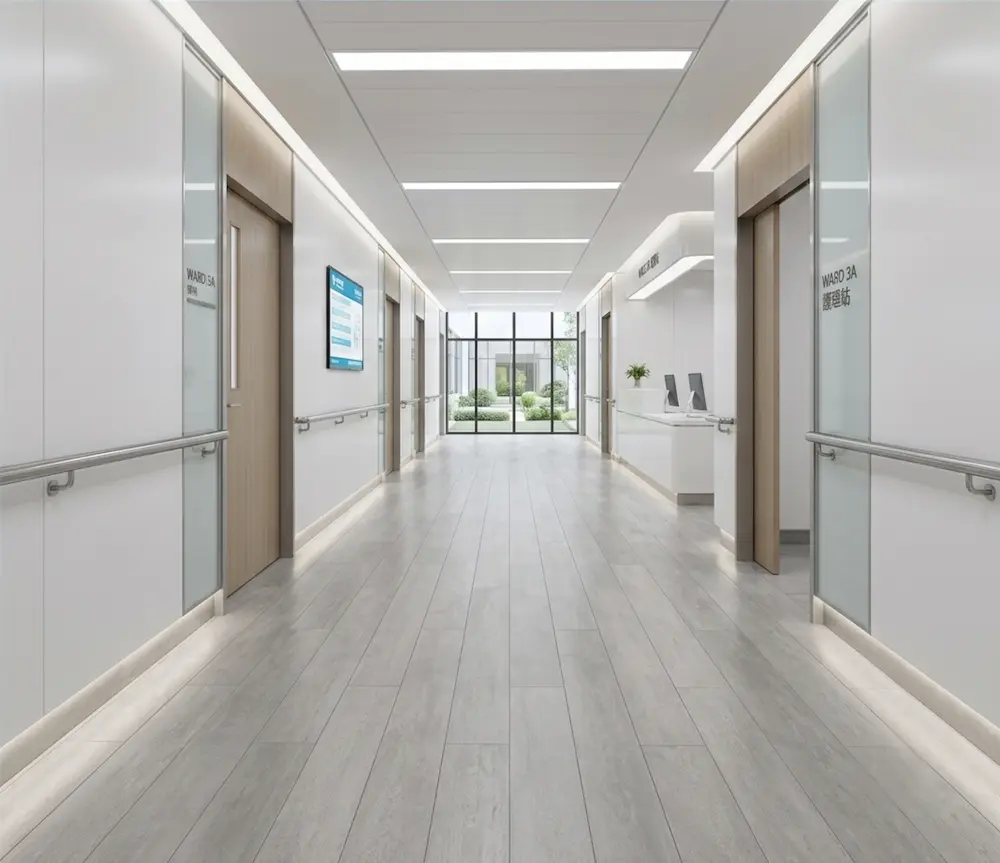
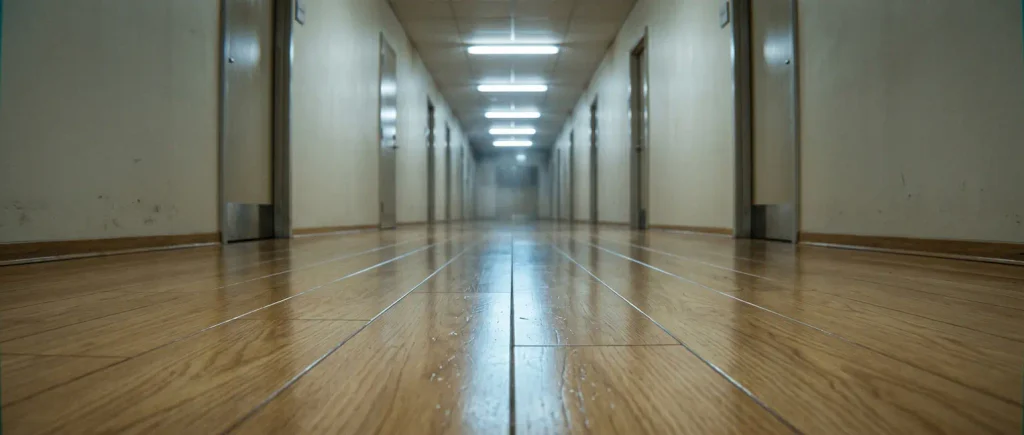
When a school procurement officer or a commercial kitchen contractor asks me about laminate flooring, the instinct of most suppliers is to redirect them straight to SPC. I understand the logic — SPC is fully waterproof, dimensionally stable, and easy to specify. But it is not always the right answer. There is a category of space where high-density laminate flooring — built around a 1000 kg/m³ HDF core — delivers performance that standard laminate cannot match. That is what MoistureShield 1000 is designed for.
What Is Actually Wrong With Standard Laminate Flooring
Laminate has spent the last decade losing shelf space to SPC, and the reason is almost always the same: water. SPC’s core is genuinely waterproof; standard laminate’s HDF core is not, and no amount of surface sealing changes that. MoistureShield 1000 exists because the laminate industry needed an answer to that gap — and raising core density to 1000 kg/m³ is the most effective lever available within the laminate category. It narrows the distance to SPC considerably. It does not close it.
Standard laminate flooring uses an HDF core with a density typically in the 750–850 kg/m³ range for standard and Asian-market brands, rising to 850–950 kg/m³ for premium European brands. The industry generally defines HDF itself as 800 kg/m³ and above, and click-lock profiles usually require at least 850 kg/m³ to hold the locking mechanism under repeated foot traffic without loosening.
The problem surfaces in spaces where humidity fluctuates, cleaning routines are aggressive, or foot traffic is sustained and heavy over years rather than months. Edge swelling is the most common failure mode. In standard HDF, the cut profile at the board edge exposes raw fiber that absorbs moisture faster than the sealed face. Once swelling begins at the joint, the click profile deforms, the surface finish lifts, and the floor becomes both an aesthetic problem and a maintenance liability. This is not a manufacturing defect — it is the material performing exactly as its specification allows. The problem is specification mismatch.
What 1000 kg/m³ Means for High-Density Laminate Performance
The Density Gap in Practical Terms
To put 1000 kg/m³ in context: even premium European-grade laminate cores typically top out around 900–950 kg/m³. MoistureShield 1000 sits above that entire range. The practical difference is not “high density versus low density” — most laminate on the market today already clears 800 kg/m³. The difference is that MoistureShield 1000 is specified above the premium tier most competitors treat as their ceiling, which translates into measurably tighter fiber compression and less void space for moisture to migrate through. On a job site, you will notice the difference in board weight when handling large quantities for a commercial installation.
How Density Affects Moisture Behavior in Practice
The key test to understand here is EN 317, which measures thickness swelling after 24 hours of full water immersion. Standard laminate cores typically show swelling well above what a correctly manufactured 1000-density core achieves under the same method. When you are evaluating a supplier’s moisture resistance claims, EN 317 test results are the evidence you should be requesting — not marketing language about “humidity-resistant finishes.”
What EN 317 Tests and What It Does Not
EN 317 measures the structural behavior of the core material under immersion. What it does not capture is the performance of the complete floor system: joint sealing quality, expansion gap management, vapor barrier adequacy, or the durability of the surface finish under repeated cleaning. A strong EN 317 result confirms the board itself is resistant. Proper installation practice remains the factor that determines long-term outcome — and no core density compensates for a missing vapor barrier or undersized expansion gap.
Where MoistureShield 1000 Belongs

School Classrooms and Educational Facilities
Schools are one of the strongest applications for high-density laminate flooring, particularly across Southeast Asia and other markets where budget pressure rules out solid wood or premium SPC but classroom conditions still demand real moisture performance. Classrooms cycle through aggressive wet-mopping routines, are occupied nine to ten months a year at high density, and operate under maintenance budgets that leave little room for error. The failure pattern with standard laminate in schools is predictable: edge lifting appears after the first year of mopping, joints open by year two, and the floor looks visually degraded well before the end of any reasonable asset lifecycle. MoistureShield 1000’s denser core handles institutional cleaning regimes considerably better.
If your project has a specific regulatory requirement — LEED certification, EU low-emission building standards, or a US-market formaldehyde mandate such as EPA TSCA Title VI — confirm MoistureShield 1000’s current certification status before specifying it; see the certification section below for exactly where this product stands today. For broader guidance on specifying flooring across different school spaces, see our dedicated School Flooring Guide. The EPA’s Indoor Air Quality in Schools resource is also a useful general reference for facility managers writing procurement specifications.
Commercial Kitchens and Food-Adjacent Environments
Flooring in food-adjacent spaces carries a specific brief: cleanable, stable underfoot, durable under rolling loads, and resistant to the moisture generated by daily operations. I need to be direct about one boundary here: fully wet zones — dishwashing stations, walk-in cooler floors, areas with routine standing water — are not appropriate for any floating laminate system, including MoistureShield 1000. Water that enters the floor through the joints will reach the subfloor; the damage is extensive and slow to reveal itself until it is expensive to address.
Where MoistureShield 1000 does belong is in the drier areas of commercial food environments: staff corridors, dry storage, break rooms adjacent to kitchen facilities, and restaurant dining areas where the floor sees regular wet-mopping but not pooled water. For guidance on selecting flooring across the full range of kitchen environments, see our article on kitchen and bathroom flooring.
Basements, Large Commercial Spaces, and Rental Properties
Basements present moisture from below rather than above — ground vapor migrating through concrete slabs. A high-density laminate flooring system handles this better than standard laminate, but the vapor barrier specification beneath the product is equally critical. Skipping or underspecifying that barrier negates the core density advantage entirely. Large commercial open-plan spaces benefit from MoistureShield 1000’s improved dimensional stability across seasonal humidity cycles, which reduces the likelihood of gapping in winter and surface buckling in summer. Rental property managers will find the combination of durability and individual plank replaceability a practical fit for high-turnover residential portfolios.
What MoistureShield 1000 Cannot Do
No product specification is useful without an honest account of its limitations.
MoistureShield 1000 is water-resistant, not waterproof. This distinction matters more than any other in this article. The 1000 kg/m³ core dramatically reduces the speed and extent of moisture absorption compared to standard laminate, but it remains a wood-fiber product at its core. Chronic standing water, plumbing discharge risk, or steam exposure will damage it over time regardless of density. SPC and ResinCore are the two products in our range that are genuinely waterproof. MoistureShield 1000 is not.
MoistureShield 1000 cannot be refinished. A laminate floor’s surface is a printed and sealed layer — once it is worn through, the plank needs replacing rather than sanding and re-coating. For specifications requiring aesthetic continuity over 30 or 40 years, engineered wood or solid teak remain the more appropriate choices. You can review the lifespan implications across flooring types in our flooring lifespan comparison.
The underfoot feel of MoistureShield 1000 is harder than solid wood or engineered wood — that trade-off is inherent to the material category, not a product-specific shortcoming. It is worth putting in context, though: at roughly 2150 kg/m³ with no wood content at all, SPC is harder still. If comfort underfoot is a primary specification criterion, MoistureShield 1000 sits in the middle of the range — softer than SPC, firmer than solid or engineered wood.
Current Certification Status and Market Fit
What MoistureShield 1000 Does Not Currently Hold
I want to be direct about this because it genuinely affects who this product is right for: MoistureShield 1000 does not currently hold CE certification or FSC Chain of Custody certification. Its formaldehyde emission class is E1, not the stricter E0 tier that some European specifications now default to.
This is not a cost-cutting decision — certification itself is a real investment of time and testing budget, and we prioritize that investment on the product lines where EU buyer demand actually requires it, which is where our SPC and engineered wood ranges carry CE and FSC today. MoistureShield 1000’s current order volume comes predominantly from markets that do not mandate CE marking, so certification for this specific line has not yet been a priority. That can change if demand shifts.
Where This Product Is Not Yet the Right Fit
For buyers sourcing into the EU construction market under CE marking requirements, or projects specifically requiring FSC-certified materials, MoistureShield 1000 is not yet the right product — our engineered wood and SPC lines carry the certifications those projects typically require, and are the products I would point EU-bound buyers toward instead.
Where MoistureShield 1000 Fits Today
Where MoistureShield 1000 fits well today is Southeast Asia and other markets where CE marking is not a regulatory requirement and E1 formaldehyde compliance meets the applicable local or export standard. E1 is what most buyers for this product currently order, and it is a widely accepted compliance tier outside the EU’s stricter CE pathway. If your project specifically requires E0, that is achievable — talk to us directly, since it is not the standard production run but can be arranged. The product’s moisture performance makes it a strong fit for institutional and commercial projects in these regions — even at a price point above standard SPC. If CE or FSC certification becomes commercially justified for this line, that will be reflected here once testing is complete.
How It Stacks Up: MoistureShield 1000 vs. Standard Laminate vs. SPC
The right choice between high-density laminate flooring, standard laminate, and SPC is not about which product is generically “better” — it is about matching the product to the performance brief. Here is how the three compare across the criteria that matter most in B2B specification:
| Feature | Standard Laminate | MoistureShield 1000 | SPC Flooring |
|---|---|---|---|
| Core material | HDF 750–950 kg/m³ | HDF 1000 kg/m³ | Stone-plastic composite |
| Moisture resistance | Moderate | High (water-resistant) | Fully waterproof (core) |
| Suitable for wet zones | No | No | No (floating system) |
| Can be refinished | No | No | No |
| Wood aesthetic register | Medium | Medium–High | Variable (EIR available) |
| Dimensional stability | Moderate | High | Very high |
| Price positioning | Below SPC | Above SPC | Mid |
| Acoustic underfoot | Better than SPC | Better than SPC | Harder |
For a full analysis of SPC versus standard laminate across multiple performance criteria, see our SPC vs. Laminate comparison.
Installing High-Density Laminate Flooring: Requirements That Actually Matter
Installing high-density laminate flooring correctly is what determines whether the material’s moisture advantage actually shows up in the field.
Moisture Barriers and Expansion Gaps
Every floating floor system — regardless of core density — requires a properly specified moisture barrier between the board and the subfloor. For concrete slabs, this means a vapor retarder film rated to the relevant code requirement for vapor transmission. The higher moisture resistance of MoistureShield 1000’s core protects against moisture from above; it does not compensate for an undersized vapor barrier below. For building science guidance on moisture management in floor assemblies, Building Science Corporation publishes well-regarded reference material on vapor control principles.
Expansion gaps at perimeter walls and fixed obstacles are non-negotiable. The board expands and contracts with ambient humidity changes, and insufficient gap causes buckling — one of the most common avoidable failures in any laminate installation. Specify 8–10mm at all fixed edges, covered by skirting board or appropriate transition profiles.
Subfloor Preparation and Acclimatization
The subfloor flatness tolerance for MoistureShield 1000 is ±3mm over a 2-meter span. Subfloors outside this tolerance create bridging between planks, concentrating load at joint edges and accelerating wear. Self-leveling compound is the standard remedy for out-of-flat concrete; timber subfloors should be checked for squeaks and loose fasteners before installation begins.
Acclimatization: allow unopened product to sit in the installation environment for at least 48 hours before laying. This allows the boards to reach equilibrium with ambient humidity and temperature, reducing the likelihood of post-installation movement. In climates with large seasonal humidity swings — above ±30% relative humidity between seasons — this step is particularly important and should be written into the installation specification.
What to Verify Before Ordering High-Density Laminate Flooring
Key Specifications to Confirm in Writing
When evaluating any high-density laminate flooring product, these are the numbers I would require documented before placing a significant order:
| Specification | What to Request | Why It Matters |
|---|---|---|
| HDF core density | Value in kg/m³ (must state ≥1000) | Central to the moisture resistance claim |
| EN 317 swelling result | % thickness swelling after 24h immersion | Verifies actual core moisture performance |
| AC wear rating | AC3 minimum for commercial; AC4 for heavy use | Surface abrasion resistance in high-traffic spaces |
| Formaldehyde class | E1, E0, CARB Phase 2, or TSCA Title VI — confirm which one applies | Emission class varies by product and market; confirm it matches your project’s requirement |
| Click system | Brand and generation (e.g., Välinge 5G) | Affects joint integrity and installation speed |
| Available plank sizes | Length × width in mm | Size selection affects spatial proportions |
These specifications apply whether you are sourcing high-density laminate flooring from us or evaluating a competing supplier.
Test Documentation to Request From Your Supplier
Request the EN 317 immersion test report, the surface abrasion result per EN 13329 Annex E — the standard that underpins AC wear ratings — and the formaldehyde emission test certificate. If the supplier cannot produce current, product-specific test documents, that is worth following up on before you commit to a large order. For products going into projects that require FloorScore certification, confirm the certificate is current and covers the specific product — not a blanket company-level certificate that may not apply to the item being shipped.
Frequently Asked Questions
Is MoistureShield 1000 fully waterproof?
No — and this distinction is important. The 1000 kg/m³ HDF core has significantly better moisture resistance than standard laminate, making it well suited to spaces with humidity variation and regular wet-mopping. It is not a fully waterproof system. Water that sits on the surface for extended periods, or enters through the joint edges from below, will cause damage over time. For spaces with genuine standing-water risk — wet bathrooms, shower floors — even SPC is not the right call, despite its waterproof core: it is still a floating floor installed over an existing surface, and joint infiltration risk remains regardless of how waterproof the core itself is. The same applies to ResinCore. Ceramic tile is the correct specification for those areas.
How does MoistureShield 1000 compare to SPC on cost?
MoistureShield 1000 is priced above standard SPC, reflecting both its thicker profile and the higher manufacturing cost of pushing the HDF core to 1000 kg/m³. This is worth understanding in context: laminate flooring has spent years losing ground to SPC precisely because standard laminate cannot match SPC’s full waterproofing. MoistureShield 1000 is the laminate industry’s answer to that competitive pressure — and it comes at a cost premium that puts it above SPC rather than below it. It is water-resistant, not waterproof; SPC remains fully waterproof regardless of price. If the brief calls for a genuine wood aesthetic with the best moisture resistance laminate can offer, and budget allows for a premium above SPC, MoistureShield 1000 is the right fit.
Can MoistureShield 1000 be installed over underfloor heating?
Yes, with conditions. The maximum surface temperature for laminate flooring over underfloor heating is typically 27°C per EN 14041. Commission the heating system and run it for several weeks before installation; reduce the temperature during and immediately after laying. Verify compatibility with your specific heating system’s output rating before specifying this combination, and request the product’s underfloor heating installation guidelines from the supplier.
What is the expected lifespan in a school environment?
In a properly installed and maintained school setting — regular cleaning routines, no standing water exposure, correctly specified vapor barrier — MoistureShield 1000 typically delivers five to ten years of serviceable life before surface wear becomes a visible concern. School floors see harder use than the material’s theoretical ceiling, since students are not treating someone else’s floor the way they would their own. This still compares favorably to standard laminate in the same environment, where edge lifting and surface wear commonly present within three to five years. Unlike wood flooring, it cannot be refinished when worn; end-of-life means replacement, not restoration.
Does MoistureShield 1000 require special underlayment?
Some versions are supplied with a pre-attached underlayer; others require separate specification. Where separate underlayment is needed — for acoustic performance, additional thermal insulation, or vapor barrier integration — IXPE and EVA foam underlays are standard options for laminate systems. Cork is an alternative for projects with premium acoustic requirements, though at higher cost. The underlayment choice directly affects IIC and STC acoustic ratings, which matter for school corridors or multi-story commercial specifications.
The Bottom Line
High-density laminate flooring at 1000 kg/m³ occupies a specific and genuinely useful position in the product range. It outperforms standard laminate on moisture resistance and dimensional stability. The cost sits above SPC — reflecting its thicker profile and higher-density core — while offering a more natural aesthetic for spaces where that matters. Water-resistant rather than waterproof, it still carries the wet-zone boundary regardless of price. None of that makes it a universal fit: it cannot be refinished, and it requires the same careful installation practice as any floating floor system — vapor barrier, expansion gaps, and flat subfloor preparation included.
For school classrooms, kitchens outside the wet zone, basements with correctly specified moisture control, and large commercial spaces where climate variation is a known variable — particularly across Southeast Asia and other markets outside the CE pathway — MoistureShield 1000 is the specification I reach for. If you are evaluating it for a project, the available plank sizes run from 600×238mm up to 1800×238mm — wide-format options that work well in large open-plan installations. Samples and a full technical data sheet are available on request.