Why This Year’s Shanghai Show Mattered More Than Usual
The Show, the Numbers, and What They Do Not Capture
Every May, the flooring industry converges on Shanghai for DOMOTEX asia/CHINAFLOOR — the largest dedicated flooring exhibition in Asia-Pacific, and by most measures the most important sourcing intelligence event on the regional calendar. The 2026 edition arrived at a moment unlike any other in recent memory. I make the trip every year, not primarily to close deals, but to read the market. The 2026 edition — held May 27 to 29 at the Shanghai National Exhibition and Convention Centre — was the 28th edition of the show, and it landed in the middle of a year unlike any other in recent memory.
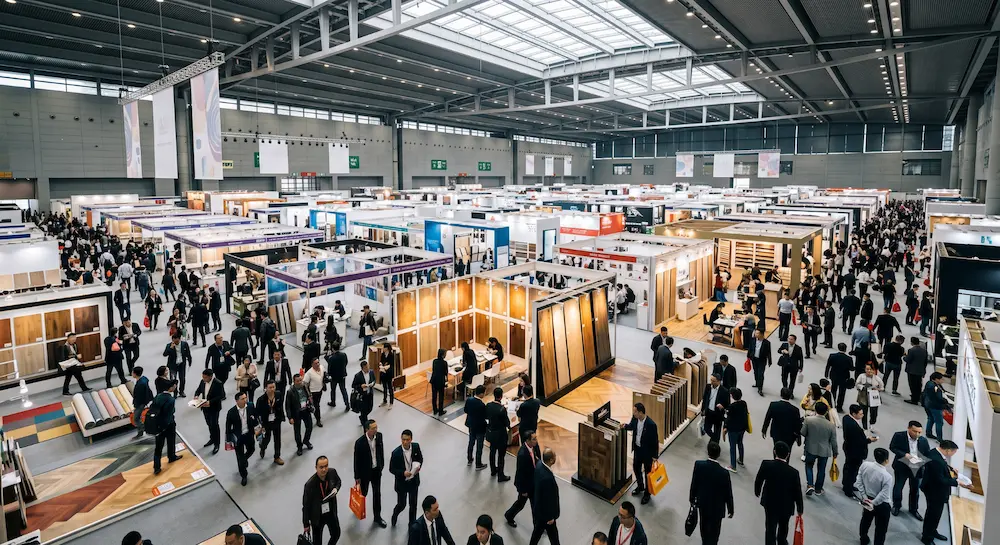
DOMOTEX asia/CHINAFLOOR 2026 welcomed 83,887 visitors from 146 countries, with international attendance reaching a record 18,302 — up from 124 countries in 2025. That headline number is impressive. But what it does not capture is the specific character of the conversations happening on the floor: anxious, specific, and shaped by pressures that have nothing to do with flooring design trends.
Three Pressures That Shaped Every Conversation
The Strait of Hormuz has been largely closed to commercial shipping since late February 2026. This happened after US and Israeli military operations triggered a rapid escalation with Iran. The EU imposed definitive anti-dumping duties of 21.3% to 36.1% on Chinese-origin multilayered wood flooring in July 2025, with an anti-absorption investigation launched in April 2026. US tariff uncertainty has pushed dozens of Chinese manufacturers to relocate production lines to Southeast Asia. Every serious buyer at the show was thinking about at least one of these things, and most were thinking about all three simultaneously.
What This Article Is About
This article is our honest read of what DOMOTEX asia/CHINAFLOOR 2026 actually looked like on the ground — not the polished version. It reflects what buyers were genuinely asking about, what manufacturers were quietly worried about, and what it means for sourcing decisions in the second half of 2026 and into 2027.
The Context No Trade Fair Press Release Will Tell You
Before any trend discussion, the macro context that shaped every conversation at the show deserves to be named directly. Three structural pressures were visible in the room in ways that product launches and booth designs were not.
The Strait of Hormuz and What It Means for Asian Flooring Supply Chains
On 28 February 2026, US and Israeli military operations against Iran triggered the closure of the Strait of Hormuz — the world’s most critical maritime chokepoint, through which approximately 25% of global seaborne oil and 20% of global LNG had previously transited. Commercial shipping traffic through the strait dropped more than 90% after the conflict began, with vessels rerouted away from both the strait and the Red Sea. As of July 2026, the situation remains volatile: a ceasefire framework reached in April has not held, and renewed attacks on commercial shipping in early July prompted UN warnings of catastrophic consequences for the global economy if full-scale conflict resumes.

For the flooring industry, the strait closure matters through two channels. The first is energy cost: raw materials for SPC flooring (PVC, limestone powder), laminate HDF cores, and adhesives are all energy-intensive to produce, and energy costs across Asia have increased significantly since late February. The second is logistics routing: vessels previously transiting the Gulf to reach ports in South and Southeast Asia have been rerouted around the Cape of Good Hope, adding weeks to transit times and significantly higher freight costs.
For Karlyn Floors, as a Taiwanese distributor with direct manufacturer relationships, this is a conversation we are well placed to have honestly. It does require planning to start earlier in the project cycle than buyers are accustomed to. If your project has a flooring delivery requirement in the second half of 2026, reach out through our Contact page now rather than when the specification is finalised.
EU Anti-Dumping Duties on Chinese Engineered Wood: What Changed and What It Means
In July 2025, the European Commission imposed definitive anti-dumping duties of 21.3% to 36.1% on multilayered wood flooring originating in China, protecting the EU’s €1.3 billion domestic industry and its 10,500 jobs. In April 2026, the European Parquet Federation requested an anti-absorption investigation. It cited evidence that Chinese exporters had been systematically reducing export prices to offset the duty impact — effectively absorbing the tariff rather than passing it through to EU buyers. The investigation is ongoing.

For distributors supplying the European market with Chinese-origin engineered wood flooring, the practical consequence is straightforward: Europe is no longer a commercially viable primary export destination for this product category from a China-origin supply chain, regardless of product quality. The duty stack — base tariff plus anti-dumping, with the absorption investigation potentially adding further adjustment — makes Chinese engineered wood uncompetitive in Europe against domestically produced alternatives. This was visible at the show in the near-absence of European buyers at booths prominently featuring engineered wood from Chinese factories. The buyers who were there for wood products were primarily from Southeast Asia, the Middle East, and Oceania — markets where Chinese-origin engineered wood remains competitive. For our Engineered Wood Flooring, this trade environment is a relevant context for any discussion of market positioning and export planning.
The Southeast Asia Factory Migration: What Is Actually Happening
The expansion of manufacturing capacity across Southeast Asia — Vietnam, Thailand, Malaysia, Indonesia — that has accelerated over the past two years is frequently described in industry media as a response to “diversification” or “regional growth.” The ground-level reality is more specific. A significant proportion of the new flooring capacity in Vietnam and Thailand represents Chinese factory owners relocating production lines. The goal is to access markets — primarily the United States — that have imposed high tariffs on Chinese-origin goods. The product, capital, management, and often the equipment are Chinese. Only the factory address is not.
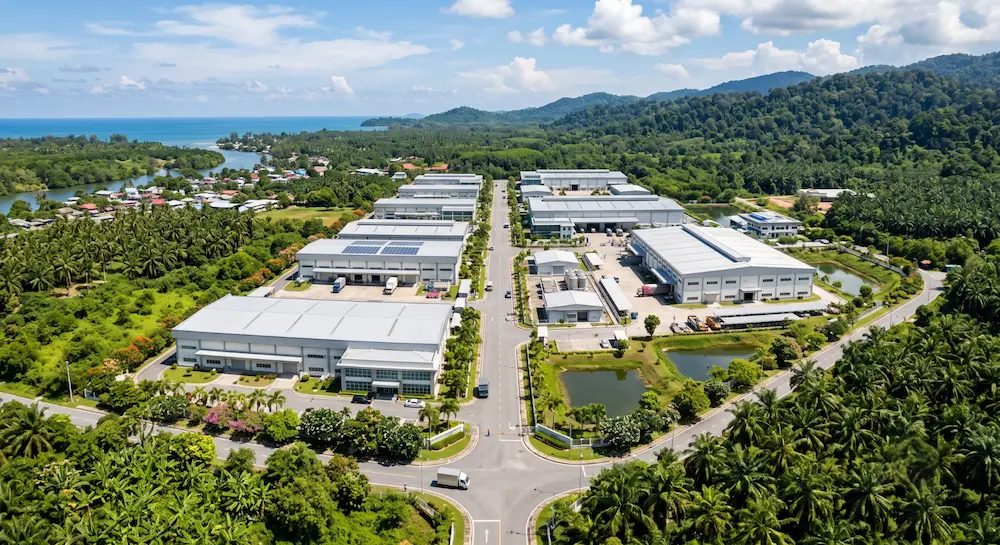
This dynamic directly explains why DOMOTEX is launching its Bangkok edition in November 2026. The Bangkok launch reflects a pragmatic commercial response to two converging developments: the shift to biennial Hannover editions, and the emergence of a substantial new manufacturing cluster in Vietnam and Thailand — one driven largely by Chinese producers relocating to access the US market at lower tariff rates. Whether this Southeast Asian cluster eventually develops genuinely independent supply chains, or remains Chinese capital in a regional address, will take time to assess. What buyers attending Bangkok can reasonably expect is a show oriented toward this new production geography, with all the sourcing opportunities — and origin documentation questions — that come with it.
What DOMOTEX asia/CHINAFLOOR 2026 Actually Looked Like
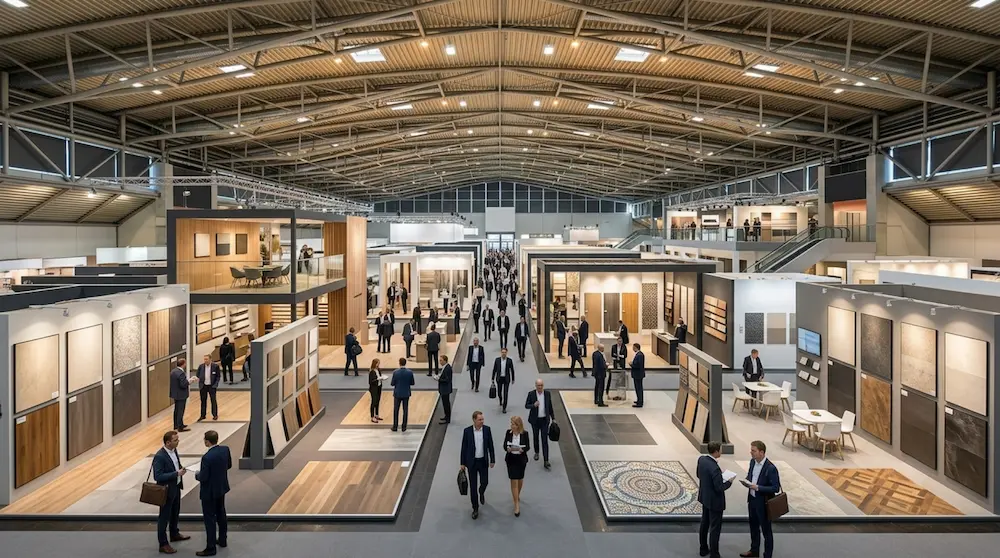
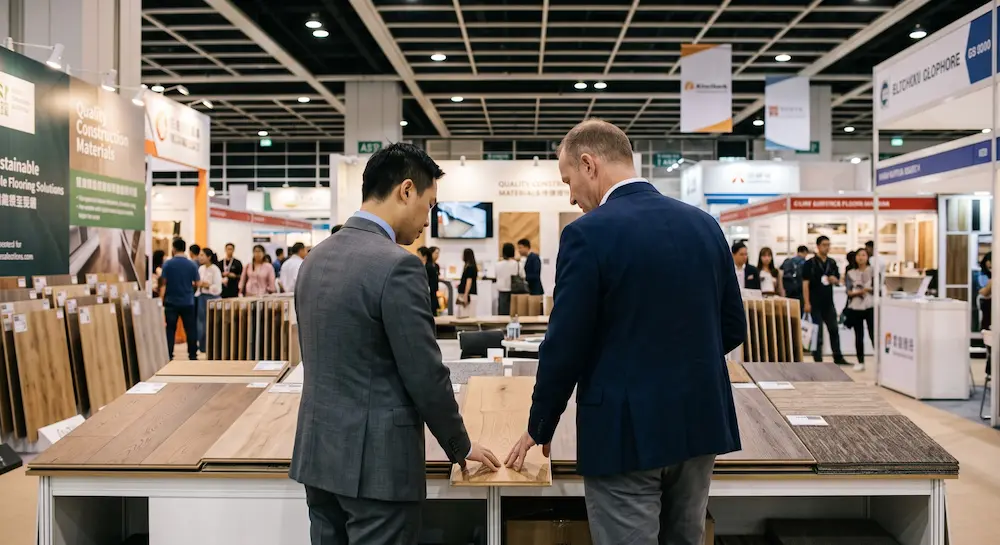
The exhibition covered 200,000 square metres across seven halls, bringing together around 1,500 brands from over 40 countries, with resilient flooring — SPC, LVT, and composite formats — occupying over 40,000 square metres with more than 450 companies. The scale is genuinely impressive. What made this year different from previous editions was the quality and specificity of the buyer conversations, shaped directly by the pressures described above.
Buyers Were More Senior and More Specific
The visitor profile at the 2026 show skewed noticeably more senior and more specification-oriented than in previous years. Procurement teams arrived with checklists — certification requirements, recycled content percentages, emission standards, supply chain transparency documentation — rather than general inspiration-gathering agendas. Organizers noted particularly strong growth from Germany, Canada, Spain, and Poland. The German and Canadian buyers in particular were navigating the EU anti-dumping environment directly: German buyers were looking for non-Chinese-origin engineered wood alternatives or for products outside the affected tariff categories; Canadian buyers were managing their own country’s tariff exposure on Chinese-manufactured goods.
Sustainability Documentation Is Now a Gate, Not a Feature
The shift in how sustainability credentials function in a buyer conversation was the clearest change from previous DOMOTEX asia/CHINAFLOOR editions. Two years ago, a third-party emission certification was a differentiator that a supplier could lead with to distinguish themselves. At the 2026 show, it was a baseline that prevented disqualification. Buyers who needed to submit ESG procurement documentation to their own clients were asking for laboratory test reports — not brand claims, not general references to compliance — as the opening question, before anything else about the product.
Three Market Signals From DOMOTEX asia/CHINAFLOOR 2026
Signal One: Supply Chain Origin Is Under Unprecedented Scrutiny
The combination of EU anti-dumping duties, US tariff pressure, and the Southeast Asia factory migration has made country-of-origin the most commercially consequential variable in flooring procurement for many buyers. At DOMOTEX asia/CHINAFLOOR 2026, buyers with European and North American end markets were asking about origin at every booth — not as a sustainability question but as a commercial necessity. A product that travels to Europe with a Chinese-origin declaration now carries a tariff burden that can exceed 36% for engineered wood, making the landed cost calculation fundamentally different from the same product with a verified non-Chinese origin.
For Karlyn Floors, as a Taiwanese distributor, this trade environment creates a specific positioning opportunity. Taiwan-origin products carry no EU anti-dumping duty on engineered wood flooring, and Taiwan’s broader trade relationships give buyers a genuinely different country-of-origin option compared with Chinese-manufactured alternatives. This is not a marketing claim — it is a tariff classification fact that buyers evaluating European or North American supply chains need to understand when assessing total landed cost. Our full product range, including Teak Solid Wood Flooring, SPC Flooring, MoistureShield 1000, and ResinCore, is available through our supply chain on terms that buyers can verify for their own compliance purposes.
Signal Two: Waterproof and Dimensionally Stable Products Are Pulling Away From the Market
SPC whole-house specification has become the mainstream residential trend in 2026, with buyers moving toward a single waterproof composite floor across all rooms rather than specifying different materials for wet and dry zones. The commercial logic is compelling: one material, one supplier, one installation team, consistent aesthetics throughout, and the waterproof performance to handle kitchens and bathrooms without a secondary specification. For our SPC Flooring and MoistureShield 1000 ranges, this whole-house specification trend increases average order volume per project and reduces the number of supplier relationships a contractor needs to manage.
Signal Three: Verified Recycled Content Is Becoming a Procurement Requirement
The shift from “we have recycled content” to “we can document recycled content to a specific percentage with a named third-party verifier” was visible across multiple booth conversations at the show. ESG reporting obligations filtering down through corporate supply chains mean that institutional buyers increasingly need to submit specific figures — not brand narratives — to their own sustainability committees. Our ResinCore flooring system, engineered from pre-consumer PCB laminate offcuts with Intertek and SGS verification, answers this question at the level of specificity that corporate procurement teams now require. The full certification portfolio is available through our Certificates and Patents page.
| Market Signal | Buyer Behaviour | Relevant Karlyn Floors Product |
|---|---|---|
| Country-of-origin under tariff scrutiny | EU/US buyers asking for origin documentation upfront | Full range — Taiwan origin, no EU anti-dumping exposure on SPC/laminate |
| SPC whole-house specification | Single-material whole-dwelling specs increasing order volume | SPC Flooring, MoistureShield 1000 |
| Verified recycled content required | Specific percentage + named verifier, not brand claim | ResinCore — PCB offcut origin, Intertek/SGS verified |
| Supply chain resilience | Buyers asking about alternative routing, lead time buffers | All products — direct manufacturer relationships, flexible logistics |
| Formaldehyde-free across all sectors | Retail and hospitality buyers asking alongside healthcare | SPC, ResinCore, Engineered Wood — CARB Phase II certified |
What Buyers Were Asking at DOMOTEX asia/CHINAFLOOR 2026
Walking a show like DOMOTEX asia/CHINAFLOOR 2026 is partly about what you see on the exhibition floor and partly about the conversations happening at the edges — between booths, at the Asia Flooring Talks sessions, over coffee. The most useful intelligence usually comes from the second category.
Lead Times, Routing, and the Logistics Reality
More buyers than in any previous year were asking specific questions about logistics: what is the current transit time to my port, what routing are you using given the Strait situation, what buffer should I build into my project schedule? These are not questions that a standard product presentation addresses, and booths that could not answer them specifically were losing credibility with serious procurement buyers. The Cape of Good Hope rerouting adds approximately two to three weeks to transit times for vessels previously routing through the Red Sea and Gulf of Oman. For projects with fixed completion dates in the second half of 2026, this means flooring orders that would previously have been placed four to six weeks before installation need to be placed eight to ten weeks out. Our team is available to discuss project-specific logistics planning for buyers with tight delivery windows.
The Tariff Conversation Buyers Did Not Expect to Have at a Flooring Show
The EU anti-dumping duty environment created a category of buyer conversation that would have been unusual at a flooring trade show five years ago: detailed questions about HS code classification, country-of-origin certification, and the difference between a factory address and a country-of-origin declaration. Buyers representing European retail chains and hospitality groups were asking suppliers not just about product specifications but about the legal documentation supporting origin claims — particularly for engineered wood products from exhibitors whose factories are in China but who were presenting products with Southeast Asian origin declarations.
The practical takeaway for buyers is that country-of-origin documentation needs to be reviewed with the same rigour as product certification documentation. A supplier who cannot provide clear, verifiable chain-of-custody documentation for their origin claim is a compliance risk, not just a commercial one. For the flooring categories most affected — engineered wood in particular — this means the total landed cost calculation for European buyers now needs to account for tariff exposure explicitly, not as a footnote but as a primary line item. Our comparison of solid wood vs engineered wood covers some of the performance trade-offs that buyers navigating this tariff environment are weighing as they evaluate alternatives.
What Comes Next: DOMOTEX Bangkok and the Road to Shanghai 2027
The next DOMOTEX asia/CHINAFLOOR will take place May 26 to 28, 2027, again in Shanghai. Before that, DOMOTEX Southeast Asia launches in Bangkok in November 2026. As discussed earlier, the Bangkok show’s emergence is directly connected to the Southeast Asian manufacturing migration driven by US tariff pressure on Chinese-origin goods — Deutsche Messe is positioning itself to serve the new production cluster that has formed in Vietnam and Thailand, regardless of where the underlying capital and management originates. For buyers attending Bangkok expecting to find genuinely independent Southeast Asian manufacturers with distinct supply chains from Chinese-origin alternatives, it is worth doing careful due diligence on the specific origin documentation and factory ownership of any supplier you evaluate there.
The broader picture for 2026 and into 2027 is one of genuine structural change, not a temporary disruption that will resolve cleanly. The Strait of Hormuz situation is actively negotiated but volatile as of July 2026, with renewed attacks on commercial shipping in early July effectively halting large vessel transit again. The EU anti-dumping investigation on Chinese engineered wood is deepening rather than resolving. US tariff policy remains uncertain. These are not background conditions that flooring buyers can treat as someone else’s problem — they are variables that directly affect which suppliers can reliably deliver, at what landed cost, on what timeline.
| Product | Key Advantage in Current Environment | Priority Market |
|---|---|---|
| Teak Solid Wood | Taiwan origin, no EU anti-dumping exposure, FSC documented | Southeast Asia luxury residential, hospitality |
| SPC Flooring | Whole-house specification trend, fully waterproof | Asia residential, Middle East commercial |
| MoistureShield 1000 | Humid-climate stability, 1000 kg/m³ acoustic mass | Southeast Asia, coastal markets |
| ResinCore | Verified recycled content, zero formaldehyde, A2-s1 | ESG-mandated institutional, healthcare |
| Laminate Flooring | Cost-effective, wide design range, fast installation | Rental properties, commercial fit-out |
Frequently Asked Questions About the 2026 Shanghai Flooring Show
What is DOMOTEX asia/CHINAFLOOR and how does it differ from DOMOTEX Hannover?
DOMOTEX asia/CHINAFLOOR is the world’s largest dedicated flooring exhibition by visitor numbers, held annually each May in Shanghai. DOMOTEX Hannover is the original global flooring show, now held every two years in January, and functions primarily as a European design and regulatory trend-setter. The two events serve fundamentally different audiences: Shanghai is an Asian manufacturing showcase and sourcing platform where buyers come to evaluate supply capability and negotiate; Hannover is a European design and specification forum where architects and institutional buyers come to set the agenda for the next two years. We attend both, and the intelligence from each informs different aspects of how we position our product range.
How is the Strait of Hormuz situation affecting flooring supply chains?
The closure and ongoing disruption of the Strait of Hormuz since late February 2026 affects the flooring industry through two channels: energy input costs (raw materials for SPC and laminate production are energy-intensive) and logistics routing (vessels rerouted around the Cape of Good Hope add two to three weeks to transit times and significantly higher freight costs compared to Gulf routing). For buyers with projects in the Middle East, South Asia, and East Africa, this means lead time planning assumptions need to be revised upward. We recommend starting logistics planning conversations eight to ten weeks before required delivery rather than the four to six weeks that was realistic before February 2026.
Why does the EU anti-dumping duty on Chinese engineered wood matter to buyers outside Europe?
It matters to non-European buyers for two reasons. First, if your supply chain eventually reaches European end markets — through a distributor, a hospitality group with European properties, or a retail chain with EU stores — the tariff exposure is relevant to your own customer’s landed cost. Second, the anti-dumping investigation has prompted a wave of supplier repositioning in which some Chinese-origin engineered wood is being presented with Southeast Asian origin declarations that may not withstand scrutiny. Buyers evaluating engineered wood from any source currently need to apply more rigorous origin documentation review than they might have previously. Our article on flooring certifications covers the documentation review process for buyers building a compliant specification package.
What is the real story behind DOMOTEX Southeast Asia in Bangkok?
DOMOTEX Southeast Asia, launching in Bangkok in November 2026, is primarily a commercial response by Deutsche Messe to two developments: the shift to biennial Hannover editions (which reduced annual revenue from that show) and the emergence of a significant new manufacturing cluster in Vietnam and Thailand driven by Chinese factory owners relocating to access the US market at lower tariff rates. The Bangkok show will be a useful sourcing event for buyers focused on Southeast Asian markets, but buyers expecting to find genuinely independent Southeast Asian manufacturers should approach exhibitor due diligence carefully and verify origin documentation rather than accepting country-of-production claims at face value.
How can I contact Karlyn Floors about supply chain and lead time planning?
For project-specific conversations about supply chain logistics, lead time planning given current routing conditions, or origin documentation for your specific compliance requirements, reach out through our Contact page. Our team is based in New Taipei City, Taiwan, and typically responds within one business day. For buyers evaluating our products after DOMOTEX asia/CHINAFLOOR 2026, we can also provide a complete documentation package — certification reports, origin documentation, and product specification sheets — formatted for your project submission requirements.
The Bottom Line: A Show That Reflected a More Complicated World
DOMOTEX asia/CHINAFLOOR 2026 was not the kind of trade fair where you leave excited about new product designs. It was the kind where you leave with a clearer — and somewhat more sober — picture of the structural pressures reshaping the flooring industry’s supply chains, trade routes, and competitive dynamics. The record visitor numbers reflected genuine demand for intelligence in a market where the variables that matter most right now are not about aesthetics or even performance but about tariffs, logistics routing, and origin documentation.
For Karlyn Floors, the show confirmed what we have been positioning for: a market that rewards suppliers who can deliver reliably, document their products completely, and be honest about the trade environment their buyers are navigating. Taiwan’s position as a manufacturing and distribution hub — outside the EU anti-dumping exposure on Chinese-origin engineered wood, with established logistics flexibility and direct manufacturer relationships — gives us a specific advantage in a sourcing environment where many buyers are actively looking to reduce their concentration risk in Chinese-origin supply chains.
We will be monitoring the Strait of Hormuz situation, the EU anti-absorption investigation, and the Bangkok show’s debut closely in the second half of 2026, and we will update our thinking as the picture evolves. In the meantime, if you are a buyer making sourcing decisions against this backdrop, the most useful conversation we can have is a specific one: your project, your compliance requirements, your delivery timeline. Start it through our Contact page or explore our full range at karlynfloors.com.