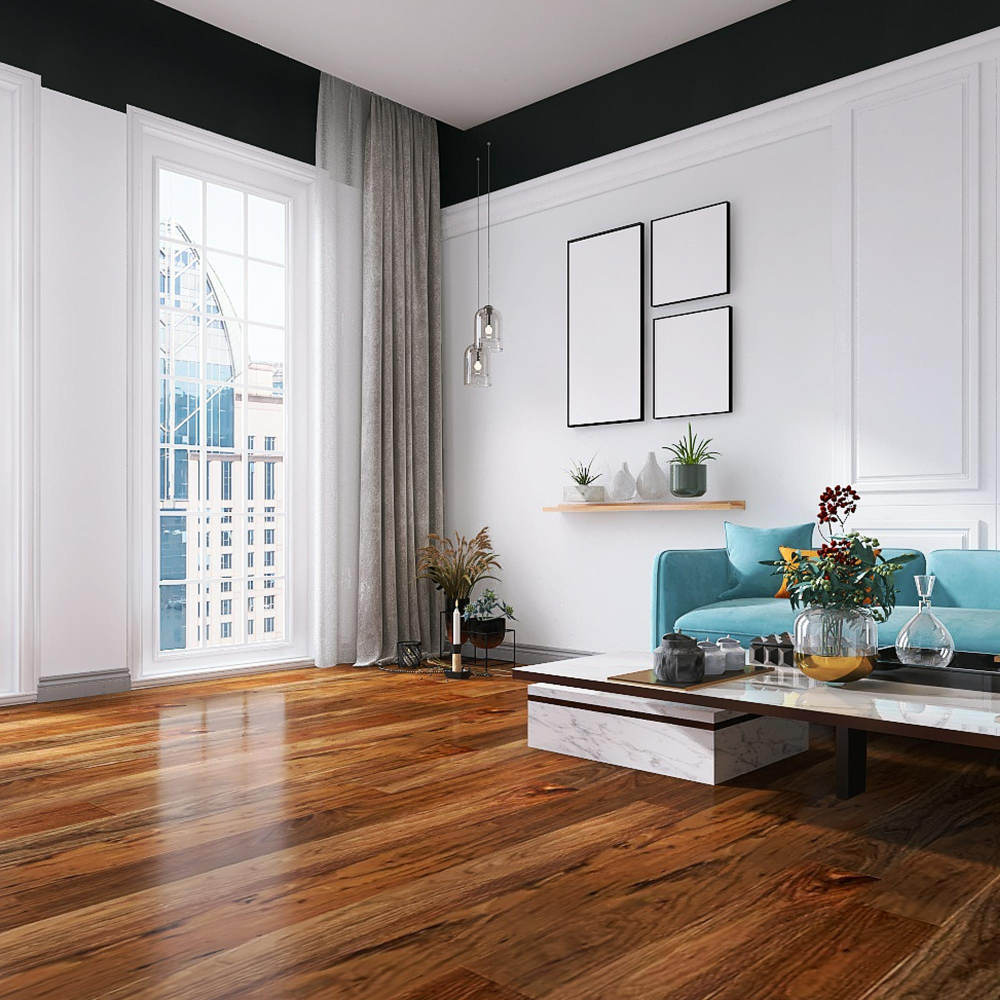

The engineered wood vs laminate decision trips up even experienced specifiers, because from across a room, the two products can look nearly identical. Both promise the warmth of wood-look flooring. They install over concrete or plywood subfloors with similar methods. Both show up on procurement shortlists for the same hotel lobby, office fit-out, or multi-unit residential development. But the materials beneath the surface are fundamentally different, and that difference drives everything from long-term maintenance budgets to how the floor ages under heavy foot traffic.
I have been distributing both product categories for over thirty years, and the question I hear most often from contractors and procurement teams is not which one looks better, but which one makes more financial sense over a ten to fifteen year lifecycle. That is the question this article answers. We will break down construction, appearance, durability, moisture performance, cost, and installation logistics, with a specific focus on how these differences play out in commercial and multi-unit projects where the wrong choice shows up in maintenance invoices long after the original specification is forgotten.
Quick Verdict: Who Should Choose Which
Engineered Wood vs Laminate Decision Table
If you need the short version before diving into the details, here is how the two materials stack up across the criteria that matter most in a B2B procurement context:
| Category | Engineered Wood | Laminate |
|---|---|---|
| Surface Material | Real hardwood veneer (2–6 mm) | Photographic print layer with melamine overlay |
| Core Construction | Cross-laminated plywood | High-density fiberboard (HDF) |
| Scratch Resistance | Moderate (depends on finish) | High (AC3–AC5 rated aluminum oxide layer) |
| Moisture Resistance | Moderate (better than solid wood) | Low to moderate (HDF core swells if exposed) |
| Refinishing | 1–3 times depending on veneer thickness | Cannot be refinished |
| Lifespan | 25–40 years | 10–20 years |
| Price Range (USD/m²) | $50–$100 | $15–$45 |
| Property Value Impact | Adds perceived value | Neutral to minimal |
| Best For | High-end residential, boutique hospitality, executive offices | Rental properties, retail, high-traffic commercial, budget renovations |
Best Scenarios for Each Material
Engineered wood wins in projects where the floor’s tactile quality matters to the end user — boutique hotels where guests walk barefoot, executive offices where flooring is part of the brand impression, and owner-occupied residences where refinishing extends the floor’s life across decades. Laminate wins in scenarios where scratch resistance, budget discipline, and fast replacement cycles are the priorities — rental apartments, retail stores, school classrooms, and large-scale commercial fit-outs where the floor needs to perform under heavy traffic without requiring periodic refinishing or intensive maintenance.
How They Are Built: Engineered Wood vs Laminate Construction
The construction difference is not a minor detail — it is the single factor that explains every other difference between these two products. Understanding what sits beneath the surface layer helps you predict how each floor will perform in the real-world conditions of your specific project.

Engineered Wood: Real Hardwood Over a Stable Core
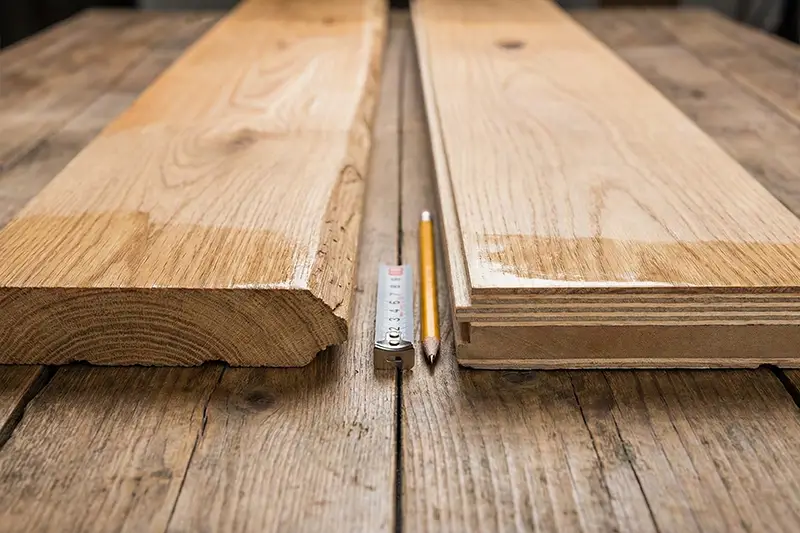
Engineered wood flooring starts with a top layer of genuine hardwood veneer — oak, walnut, teak, maple, or other species — typically between 2 and 6 mm thick. This veneer is bonded to a base of cross-laminated plywood or, in some products, an HDF core. The cross-grain arrangement of the base layers is what gives engineered wood its dimensional stability advantage over solid wood: each layer’s grain runs perpendicular to the one below it, distributing stress from humidity changes across the full thickness of the plank rather than allowing the board to cup or bow in a single direction. The result is a floor that looks and feels like solid hardwood but tolerates a wider range of environmental conditions, including compatibility with underfloor heating systems. Our engineered wood flooring range includes oak, walnut, and teak veneers in plank and herringbone formats, all built on cross-laminated plywood cores with Valinge click-lock profiles.
Laminate: Printed Image Over a Dense Fiberboard Core
Laminate flooring takes a different approach entirely. The top layer is not wood at all — it is a high-resolution photographic image of wood grain, printed onto a decorative paper and protected by a melamine resin overlay infused with aluminum oxide particles. This overlay is what gives laminate its impressive scratch resistance, rated under the EN 13329 Abrasion Class system from AC1 (light residential) to AC5 (heavy commercial). Below the decorative layer sits an HDF core, typically 8 to 12 mm thick, which provides structural rigidity and supports the click-lock installation system. A balancing layer on the bottom prevents warping. The entire assembly is engineered for consistency — every plank in a batch matches perfectly, which is both an advantage and a giveaway. Explore our laminate flooring collection to see the range of AC4 and AC5 options available for commercial specification.
Appearance and Feel: The Difference You Can See and Touch
From a distance or in a photograph, distinguishing engineered wood vs laminate flooring is genuinely difficult. Up close, the difference becomes obvious, and underfoot, it is unmistakable.
Engineered wood has the natural grain variation, colour depth, and tactile warmth of real hardwood, because the surface is real hardwood. No two planks are identical, which creates the visual complexity that interior designers and architects value in premium spaces. The wood surface develops a patina over time, and different finishes — brushed, hand-scraped, oiled, or lacquered — create distinct textures that a photographic layer cannot replicate at close range.
Laminate’s photographic technology has improved dramatically over the past decade. Embossed-in-register (EIR) finishes now align the printed texture with the visible grain pattern, creating a convincingly wood-like appearance at moderate viewing distances. However, laminate feels harder and slightly hollow underfoot compared to engineered wood, particularly in floating installations without high-quality acoustic underlay. The surface temperature tends to feel cooler and less organic, which matters in spaces where barefoot use is common — hotel rooms, residential living areas, and wellness centres. In commercial corridors, retail stores, and office spaces where occupants are typically wearing shoes, this tactile difference is much less relevant.
Engineered Wood vs Laminate: Performance Head to Head
Scratch and Wear Resistance
This is where laminate has a genuine, measurable advantage. The aluminum oxide wear layer on a quality AC4 or AC5 laminate floor is harder than most wood species, resisting scratches from chair legs, high heels, pet claws, and dragged furniture far more effectively than any wood surface finish. In independent testing under EN 13329, AC5 laminates withstand over 6,500 Taber abrasion cycles before showing visible wear — a level of surface durability that no wood veneer can match without a factory-applied aluminum oxide finish of its own.
Engineered wood’s scratch resistance depends heavily on its finish. Factory-applied UV-cured aluminum oxide finishes on premium products approach laminate-level scratch resistance, but standard polyurethane or oiled finishes are significantly more susceptible to surface marking. The trade-off is that engineered wood can be sanded and refinished when surface wear accumulates, restoring it to near-original condition. Laminate cannot be refinished — once the wear layer is compromised, the floor must be replaced. This distinction is the core of the engineered wood vs laminate lifecycle calculation, and it is the reason engineered wood often wins on total cost of ownership in spaces where a 25-year or longer service life is expected.
Moisture and Humidity Response
Neither engineered wood nor standard laminate is waterproof, but they fail in different ways when exposed to moisture, and understanding those failure modes matters for specification decisions.
Engineered wood’s cross-laminated construction resists the expansion and contraction that plagues solid wood in humid environments, but the real hardwood surface layer can still be damaged by standing water or sustained high humidity. Spills need to be wiped up promptly, and installation in wet areas like bathrooms is not recommended without additional waterproofing measures. For projects in consistently humid climates, our solid wood vs engineered wood comparison discusses dimensional stability in more detail.
Laminate’s HDF core is particularly vulnerable to moisture at the joints. When water penetrates the click-lock seams, the fiberboard core absorbs it and swells irreversibly — the resulting edge swelling is visible, permanent, and cannot be repaired without replacing the affected planks. This is the single biggest reason standard laminate fails in kitchens, bathrooms, and ground-floor installations where subfloor moisture is a risk. For projects where laminate’s cost and scratch resistance are attractive but moisture exposure is a concern, our MoistureShield 1000 addresses this directly with a 1,000 kg/m³ density HDF core that delivers significantly better moisture resistance and dimensional stability than standard 600–800 kg/m³ HDF laminate.
Sound and Comfort
Acoustic performance is an underspecified criterion in too many commercial projects, and it is an area where engineered wood outperforms laminate by a noticeable margin. Engineered wood’s denser construction and real wood surface absorb more impact sound than laminate’s rigid HDF-and-melamine sandwich, resulting in less of the hollow tapping sound that characterises laminate floors in floating installations. Both products benefit substantially from quality acoustic underlay, but engineered wood starts from a better baseline. In multi-storey residential and hospitality projects where Impact Insulation Class ratings matter for occupant satisfaction, this difference can influence both material choice and underlay specification.
Cost, Installation, and Maintenance
The price gap between engineered wood vs laminate is significant at the point of purchase, but the total cost picture shifts when you factor in lifespan, maintenance, and replacement cycles. For a B2B buyer evaluating a ten to fifteen year window, the per-square-metre price is only the beginning of the calculation.
| Cost Factor | Engineered Wood | Laminate |
|---|---|---|
| Material Cost (USD/m²) | $50–$100 | $15–$45 |
| Installation Methods | Floating, glue-down, nail-down | Floating (click-lock) |
| Installation Speed | Moderate | Fast |
| Maintenance | Periodic refinishing (every 7–10 years) | Sweep and damp mop only |
| Replacement Cycle | 25–40 years | 10–20 years |
| Total Cost Over 30 Years | 1 installation + 2–3 refinish cycles | 2–3 full replacements |
Laminate’s lower upfront cost makes it the default choice for budget-constrained projects, and its click-lock-only installation means faster completion with fewer specialist requirements. For rental properties, retail spaces with frequent tenant turnover, and any project where the floor will be replaced within a decade regardless of condition, laminate is the pragmatic choice. Engineered wood costs more upfront but reduces lifecycle cost in owner-occupied or long-tenancy commercial spaces, where the ability to refinish the surface avoids the disruption and expense of full floor replacement every ten to fifteen years.
When Each One Wins in Commercial Projects

The engineered wood vs laminate decision in a commercial context is less about which product is better in the abstract and more about which product fits the specific operational reality of each project type.
For a boutique hotel lobby or a high-end co-working space, engineered wood delivers something laminate cannot: the authentic visual and tactile experience that signals quality to guests and members. The floor becomes part of the brand. A developer finishing fifty rental apartments on a tight timeline and budget would be making an expensive mistake choosing engineered wood — laminate’s speed of installation, consistency across units, and replaceability at tenant turnover make it the operationally smarter choice.
Zone-by-Zone Specification in Offices and Retail
Office fit-outs typically fall somewhere between these extremes. Executive floors and reception areas often specify engineered wood for the impression it creates, while general office areas and corridors use laminate for its scratch resistance under rolling office chairs and its lower replacement cost. This zone-by-zone approach, which we also recommend in our SPC vs laminate flooring comparison, keeps the total project budget realistic while concentrating the premium material where it has the most visual impact. Retail environments present a slightly different calculus: high-traffic aisles benefit from AC5 laminate’s surface toughness, but feature areas and brand display zones often use engineered wood or wood-look alternatives to signal product quality. The flooring becomes a merchandising tool, and the material choice should follow the brand’s positioning rather than defaulting to the cheapest option across the entire sales floor.
For projects where moisture performance is a concern alongside the cost advantages of laminate, it is worth evaluating high-density laminate options like MoistureShield 1000 rather than defaulting to standard laminate or jumping to a different product category entirely. The 1,000 kg/m³ HDF core closes much of the moisture performance gap without the price step-up to engineered wood.
Sustainability and Certifications
Environmental performance matters increasingly in B2B procurement, particularly for projects pursuing green building certifications like LEED, WELL, or BREEAM. The engineered wood vs laminate sustainability comparison is less clear-cut than many specifiers assume.
Engineered wood uses less hardwood per square metre than solid wood, since only the top 2–6 mm is hardwood veneer. However, the plywood core still requires timber, and total wood consumption is higher than laminate. When sourced from responsibly managed forests certified by the Forest Stewardship Council (FSC), engineered wood’s environmental profile improves significantly. Our wood products carry FSC certification, providing documented chain-of-custody verification for clients who need it for their own sustainability reporting.
Laminate uses less virgin wood overall — the HDF core is made from wood fibers, often including a proportion of recycled content. However, the melamine resin overlay and photographic layer mean laminate is harder to recycle at end of life than engineered wood. Formaldehyde emissions from the HDF core are a specification concern for both categories: look for products certified under CARB Phase II or EN 717-1 E0 standards. For SPC and laminate products, FloorScore certification provides independent verification of indoor air quality performance, which Karlyn Floors maintains across our SPC range.
For projects targeting LEED or WELL credits, an Environmental Product Declaration from the manufacturer provides verified lifecycle data on embodied carbon, raw material sourcing, and end-of-life recyclability. The International EPD System maintains a public database of verified declarations that procurement teams can reference when comparing products across suppliers. Both engineered wood and laminate manufacturers increasingly publish EPDs, though coverage is still patchy — requesting one from your supplier before finalising a specification is a reasonable due diligence step that also strengthens the project’s sustainability documentation trail.
Frequently Asked Questions
Can you tell the difference between engineered wood and laminate once installed?
At a glance from across a room, no. Up close and underfoot, yes. Engineered wood has natural grain variation that differs from plank to plank, a warmer surface feel, and visible wood texture that changes with light angle. Laminate’s photographic layer is consistent and precise, which is both its strength (uniform appearance across large areas) and its limitation (visible pattern repeats in expansive installations). If you kneel down and look at the surface grain at close range, the difference is immediately apparent to most people. In a well-lit showroom or a furnished room where the floor is partly covered, the distinction matters less than in a large open commercial space where the floor is the dominant visual element.
Is engineered wood or laminate better for underfloor heating?
Engineered wood is the better choice for underfloor heating systems. Its cross-laminated construction handles the thermal cycling without the dimensional movement that solid wood experiences, and the real wood surface conducts heat more naturally than laminate’s melamine overlay. Most engineered wood manufacturers specify a maximum surface temperature of 27 degrees Celsius for their products over radiant heat systems. Laminate can be used over underfloor heating with proper underlayment, but the HDF core’s lower thermal conductivity means the floor warms more slowly and the surface never feels quite as naturally warm as real wood.
Which flooring is better for rental properties?
Laminate, in almost every case. The combination of lower material cost, faster installation, higher scratch resistance, and easy full-replacement at tenant turnover makes laminate the operationally practical choice for rental portfolios. Engineered wood’s refinishing advantage only pays off when the same owner plans to maintain the floor over multiple decades, which is not the typical rental property model. The exception is premium rental units targeting long-term tenants at higher price points, where engineered wood flooring can justify a rent premium that more than offsets the material cost difference.
How do AC ratings work for laminate, and should I care?
AC stands for Abrasion Class, a standardised rating system under European norm EN 13329 that measures how well a laminate floor’s wear layer resists surface abrasion. Ratings range from AC1 (light residential) to AC5 (heavy commercial), based on the number of Taber abrasion cycles the surface withstands before showing visible wear. For commercial projects, specify AC4 or AC5. For residential use, AC3 is adequate. Importantly, the AC rating measures surface abrasion only, not impact resistance, moisture resistance, or joint durability, so it should be evaluated alongside other performance specifications rather than treated as a single indicator of overall floor quality.
Does Karlyn Floors offer both engineered wood and laminate?
Yes. We distribute both product categories, along with SPC, teak solid wood, MoistureShield 1000 high-density laminate, and ResinCore recycled epoxy resin flooring. Our product range is structured so that clients can source multiple flooring types for different zones within the same project through a single distributor, with consistent documentation, certification, and logistics. All products come with full origin documentation, and our certifications include ISO 9001, CE, FloorScore, and FSC. Visit our certifications page for details, or contact our team for project-specific specification support.
Conclusion: Match the Material to the Project, Not the Other Way Around
The engineered wood vs laminate choice is not a quality judgment — it is a fit judgment. Engineered wood delivers authentic aesthetics, refinishing potential, and long-term value in spaces where those qualities justify the higher upfront investment. Laminate delivers scratch resistance, budget discipline, and operational simplicity in spaces where durability and cost-efficiency outweigh tactile premium. Mixing both materials within the same project — engineered wood in the high-visibility zones, laminate in the high-traffic utility zones — is a specification strategy that many experienced commercial designers use to balance budget and impact.
If you are evaluating both options for an upcoming project and want to compare materials side by side, our team can provide samples, specification sheets, and pricing for both categories through a single point of contact. Every product we distribute comes with verified origin documentation and internationally recognised certifications, because getting the material right is only half the job — being able to prove it is the other half.