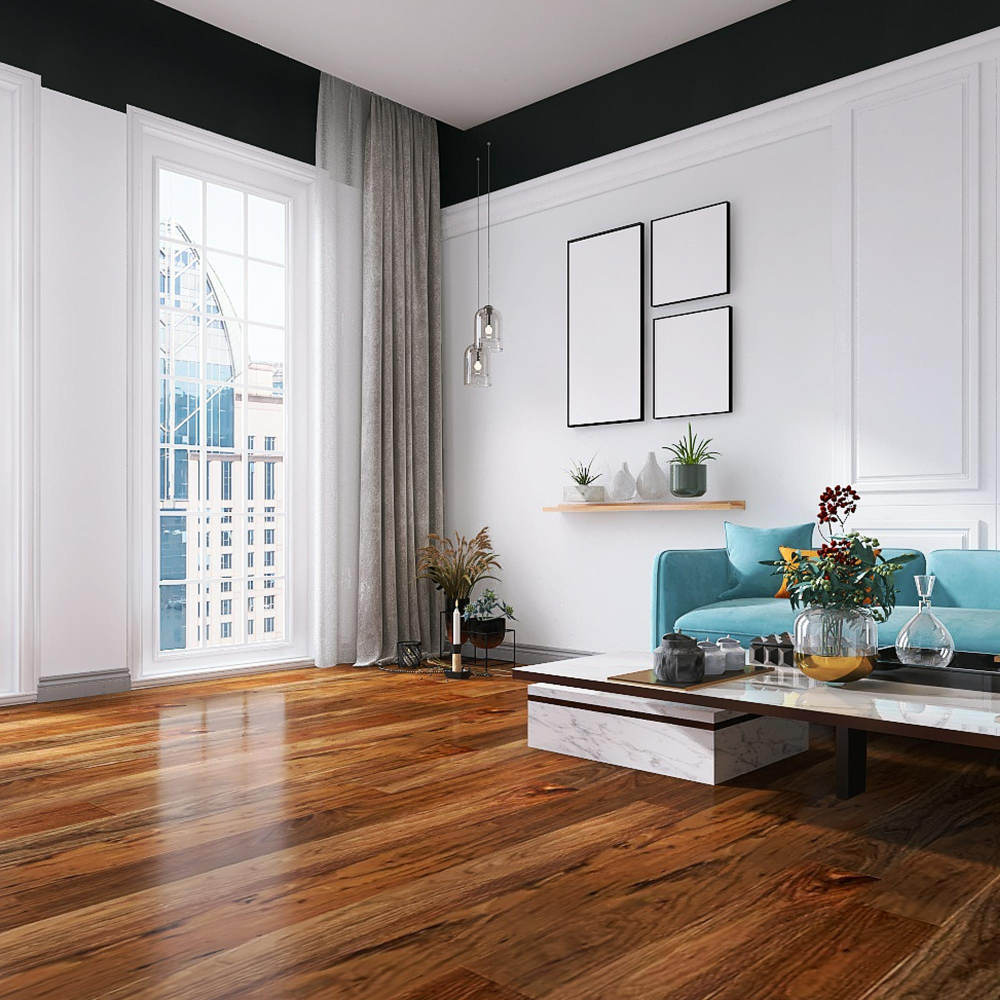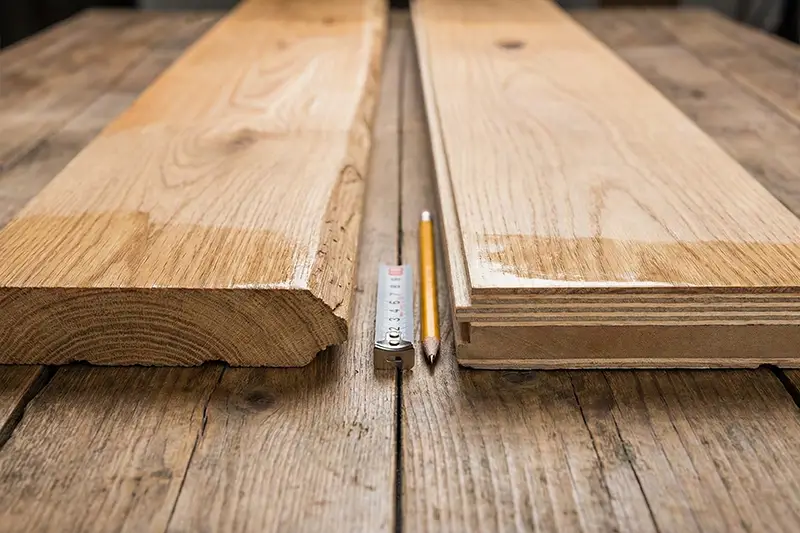

No hard flooring material is truly soundproof. That word gets used loosely in product marketing, but the physics are clear: a rigid plank sitting on a rigid subfloor will transmit impact sound to the space below. The question is not whether it transmits sound, but how much — and whether the floor assembly, including the underlay, can reduce that transmission enough to meet the acoustic requirements of the space.
This distinction matters because soundproof flooring decisions are often made based on the flooring material alone, ignoring the underlay that actually does most of the acoustic work. I have seen hotel projects specify premium engineered wood for guest rooms and then skip the acoustic underlay to save budget — resulting in a beautiful floor that transmits every footstep to the room below. The material cost was right. The acoustic performance was a failure.
This guide breaks down the acoustic performance of every major flooring category, explains the two metrics that actually matter, and provides practical specification guidance for the environments where sound control is most critical: multi-storey residential, hotels, offices, and schools.
The Two Metrics That Matter: IIC and STC
Before comparing materials, you need to understand the two numbers that define floor acoustic performance. They measure different types of sound, and a floor can perform well on one while failing on the other.
Impact Insulation Class (IIC)
IIC measures how well a floor-ceiling assembly blocks impact sound — footsteps, dropped objects, rolling chairs, dragged furniture. This is the metric that matters most for flooring decisions because the floor surface is where impact sound originates. IIC is tested under ASTM E492 using a standardised tapping machine that simulates footstep impacts at controlled frequencies from 100 to 3150 Hz. The resulting data is converted into a single IIC number — higher means better sound blocking.
The International Building Code Section 1206.3 requires a minimum lab-tested IIC rating of 50 for floor-ceiling assemblies in multi-family residential buildings. The ICC recommends IIC 55 for “Acceptable” and IIC 60 for “Preferred” performance. However, many building occupants find even IIC 55 unsatisfactory for daily living — a reality that leads experienced specifiers to target IIC 60 or above for any project where occupant satisfaction matters.
Sound Transmission Class (STC)
STC measures how well an assembly blocks airborne sound — voices, music, television, mechanical equipment noise. STC is tested under ASTM E90 and is primarily a function of the overall floor-ceiling assembly mass, not the flooring material alone. A concrete slab with any flooring material will achieve a higher STC than a lightweight wood-framed floor with the same flooring, because mass blocks airborne sound more effectively than any surface treatment.
For most soundproof flooring specification decisions, IIC is the controlling metric. A floor that achieves IIC 60 will almost always achieve STC 50 or above as well, because the underlay systems that improve impact sound performance also contribute to airborne sound reduction. The reverse is not true — a floor with high STC but low IIC will block the television noise from downstairs while transmitting every footstep from upstairs.
Lab Ratings vs Real-World Performance
One critical caveat: laboratory IIC ratings tested under ASTM E492 are measured in controlled facilities that suppress flanking transmission — sound that travels around the floor assembly through walls, columns, and other structural connections. Field IIC ratings, measured under ASTM E1007 in actual buildings, are typically 5 to 10 points lower than lab ratings for the same assembly. This means a floor assembly that tests at IIC 55 in the lab may only achieve IIC 45 to 50 in the field. Specify to the field requirement, not the lab number, and budget for the performance gap.
Soundproof Flooring Performance by Material
The flooring material itself contributes only part of the acoustic equation — typically 5 to 15 IIC points depending on the material’s density, rigidity, and backing composition. The underlay and subfloor construction contribute the rest. But the material choice does matter, because different materials interact with underlay systems differently and have different baseline acoustic characteristics.
| Material | Baseline IIC (Direct on Concrete, No Underlay) | Typical IIC with 2mm Cork Underlay | Typical IIC with 2mm IXPE/EVA Underlay (15x) | Acoustic Character |
|---|---|---|---|---|
| Engineered Wood (floating) | 35–40 | 52–58 | 50–55 | Warm, natural sound absorption |
| SPC (floating) | 32–38 | 50–56 | 48–53 | Harder, more reflective than wood |
| Laminate (floating) | 30–35 | N/A (laminate pairs with IXPE or EVA) | 46–52 | Hollow tapping sound, most reflective |
| Carpet (for reference) | 55–65 | 65–75 (with pad) | N/A | Best acoustic performer, baseline reference |
Engineered Wood: Best Acoustic Baseline Among Hard Floors
Engineered wood flooring has the best acoustic baseline of any hard flooring material because its real wood surface and multi-layer construction absorb more impact energy than the rigid, homogeneous structures of SPC and laminate. The natural grain structure of the wood veneer dissipates vibration more effectively than printed melamine or stone-plastic composite surfaces. In floating installations with 2mm cork underlay, engineered wood assemblies typically achieve IIC 52 to 58 — within range of the IIC 55 target that most hotel brands and premium residential projects specify.
SPC: Harder Surface, Higher Acoustic Investment Needed
SPC flooring has a lower acoustic baseline than engineered wood because the stone-plastic composite core is denser and more rigid, transmitting impact energy more efficiently to the subfloor. The harder surface also generates more audible sound at the point of impact — the “clicking” or “tapping” that occupants hear in the room itself, separate from the sound transmitted to the space below.
Pairing SPC with a 2mm cork underlay addresses this limitation effectively, bringing the assembly from IIC 32-38 up to IIC 50-56 — meeting the requirements of most commercial soundproof flooring specifications. The cork underlay is a buyer-selected option installed as a separate layer during floor preparation, not a built-in feature of the SPC plank itself. For projects where cork’s premium pricing is a concern, a 2mm EVA or IXPE underlay provides a more affordable alternative, though with slightly lower acoustic performance.
Laminate: The Acoustic Challenge
Laminate flooring has the lowest acoustic baseline of the three hard flooring categories. The combination of a rigid HDF core, a thin melamine surface, and the air gap created by floating installation produces the characteristic hollow tapping sound that is laminate’s most common complaint. Without underlay, laminate on concrete achieves IIC 30 to 35 — well below code minimum and unsuitable for any multi-storey application.
Acoustic underlay brings laminate into acceptable range for some applications — IIC 46 to 52 with 2mm IXPE or EVA underlay. Laminate is typically paired with IXPE or EVA rather than cork, as cork’s premium pricing does not align with laminate’s budget-oriented positioning. For projects where laminate’s cost advantage is essential but acoustic performance cannot be compromised, our MoistureShield 1000 with its denser 1000 kg/m³ core transmits marginally less impact energy than standard 600 to 800 kg/m³ laminate, though the difference is modest — typically 1 to 3 IIC points.
The Underlay Factor: Where Most of the Acoustic Work Happens
If the flooring material contributes 5 to 15 IIC points, the underlay contributes 15 to 25. This is why underlay specification is the most important acoustic decision in any soundproof flooring project — and why it is the component that should never be value-engineered out of the budget.

Cork Underlay
Cork is the most expensive acoustic underlay option but delivers the best performance. Its closed-cell structure provides excellent vibration decoupling, and it does not compress permanently under sustained load the way foam-based underlays can. A 2mm cork underlay typically adds 15 to 20 IIC points to any hard flooring assembly. Cork is the standard pairing for engineered wood and SPC in premium specifications — hotels, luxury residential, and any project targeting IIC 55 or above. It is not typically paired with laminate due to the cost mismatch between a premium underlay and a budget flooring material.
IXPE Foam Underlay
IXPE (irradiation cross-linked polyethylene) foam is the mid-range option — more expensive than EVA but less than cork, with clean, odour-neutral performance. The material is available in different density grades expressed as a multiplier: 15x is the industry standard, while 10x is denser, provides better acoustic performance, and costs more. A 2mm IXPE underlay at 15x density adds 12 to 16 IIC points. Upgrading to 10x density adds 14 to 18 IIC points at the same thickness — a meaningful improvement for projects that need to reach IIC 50 or above without the cost of cork.
EVA Foam Underlay
EVA (ethylene vinyl acetate) foam is the most affordable underlay option. It is manufactured from recycled materials, which gives it a cost advantage but also produces a noticeable plastic odour that is stronger than IXPE — a consideration for enclosed spaces with limited ventilation. The upside of the recycled content is that EVA achieves higher density than IXPE at equivalent thickness, resulting in slightly better acoustic performance.
Like IXPE, EVA comes in multiplier grades: 15x is standard, 10x is denser and more effective. A 2mm EVA underlay at 15x density adds 13 to 17 IIC points. EVA is the standard pairing for laminate flooring installations and a practical choice for commercial SPC installations where the budget does not justify cork or IXPE. The pricing hierarchy for underlay is cork (highest), IXPE (mid-range), and EVA (lowest). For budget-conscious soundproof flooring projects, EVA paired with SPC or laminate delivers the best acoustic value per dollar.
Acoustic Requirements by Application
Different environments have different acoustic requirements, and the soundproof flooring specification should match the application rather than defaulting to a generic target.
| Application | Minimum IIC Target | Recommended IIC | Key Concern | Recommended Assembly |
|---|---|---|---|---|
| Hotel Guest Rooms | 50 | 55–60 | Footsteps from room above | Engineered wood + 2mm cork underlay, or SPC + 2mm cork underlay |
| Multi-Family Residential | 50 (IBC code) | 55–60 | Daily living noise between units | Engineered wood + 2mm cork underlay |
| Open-Plan Office | 45 | 50–55 | Chair movement, footsteps | SPC + 1.5mm IXPE underlay |
| School Classroom | 45 | 50–55 | Speech intelligibility | SPC + 2mm cork underlay |
| Hotel Corridor | 45 | 50 | Luggage wheels, cleaning equipment | SPC + 1.5mm IXPE underlay |
| Retail | No code requirement | 40–45 | Customer comfort | SPC or laminate, underlay optional |
For a deeper dive into zone-by-zone specification for specific building types, our hotel flooring guide, office flooring guide, and school flooring guide cover acoustic requirements alongside other performance criteria for each zone. The WELL Building Standard’s Sound concept provides an additional framework for projects pursuing WELL certification, with specific thresholds for background noise and reverberation time.
Common Soundproof Flooring Specification Mistakes

The most frequent soundproof flooring failures I have seen in three decades of flooring distribution are not material failures — they are specification failures. The flooring material performs exactly as its data sheet promises. The problem is that the specification did not account for the complete acoustic picture.
Specifying the flooring material without specifying the underlay. This is the most common and most costly mistake. A premium engineered wood floor installed direct on concrete without underlay achieves IIC 35 to 40 — fifteen to twenty points below code minimum for multi-storey residential. The underlay that would have brought it to IIC 55 costs $3 to $8 per square metre. The remediation cost when the building fails its acoustic inspection is orders of magnitude higher.
Using lab IIC numbers for field performance expectations. Lab ratings tested under ASTM E492 suppress flanking transmission. Field performance is 5 to 10 IIC points lower. A specification that targets IIC 50 using a lab-rated IIC 50 assembly will fail in the field. Target IIC 55 to 60 in lab testing to achieve IIC 50 to 55 in the installed building.
Treating the underlay as a value-engineering target. When budgets get tight, the underlay is often the first item reduced or eliminated because it is invisible once installed. This is exactly backwards — the underlay is the highest-impact acoustic investment in the entire floor assembly, delivering more IIC improvement per dollar than any other component. Cutting the underlay specification from 2mm cork to 1mm foam can drop the assembly’s IIC by 8 to 12 points, turning a compliant floor into a non-compliant one. This single decision can turn a compliant soundproof flooring assembly into a failed one.
Frequently Asked Questions
Which flooring material is the quietest?
Among hard flooring options, engineered wood with 2mm cork underlay in a floating installation typically achieves the best acoustic performance at IIC 52 to 58. SPC with 2mm cork underlay reaches IIC 50 to 56. Carpet remains the quietest flooring material overall at IIC 65 to 75, but it is not suitable for many commercial and hospitality applications.
What IIC rating should I specify for a hotel?
Most international hotel brands specify IIC 50 as a minimum for guest room floor assemblies, with luxury brands targeting IIC 55 to 60. Given the 5 to 10 point gap between lab and field performance, specify a lab-rated IIC 60 to achieve field performance of IIC 50 to 55. Guest satisfaction surveys consistently show that footstep noise from the room above is among the top complaints in hotel reviews — making acoustic performance a direct revenue factor, not just a code compliance issue.
Does SPC flooring need underlay for soundproofing?
Yes. SPC planks ship without any acoustic backing — the underlay is always a separate, buyer-selected component installed during floor preparation. Standard SPC without underlay achieves IIC 32 to 38 on concrete — well below code minimum for any multi-storey application. Adding 2mm cork underlay brings this to IIC 50 to 56. For budget-conscious projects, 2mm IXPE or EVA underlay achieves IIC 48 to 53. Choosing a denser 10x multiplier over the standard 15x improves performance by 2 to 4 IIC points at the same thickness.
Is thicker underlay always better for soundproofing?
Not necessarily. Thicker underlay provides better vibration decoupling and higher IIC improvement, but it can also compromise the stability of click-lock joints in floating installations. Most flooring manufacturers specify a maximum underlay thickness of 2 to 3mm for their floating floor products. The NALFA certification program includes acoustic testing protocols that validate underlay compatibility with specific laminate products. Exceeding this can cause joint separation, plank movement, and premature click-lock failure — which creates noise problems that are worse than the acoustic improvement the thicker underlay was supposed to provide. Always check the flooring manufacturer’s underlay specification before increasing thickness.
Can I improve soundproofing after the floor is already installed?
Options are limited. Adding carpet or rugs over hard flooring reduces in-room impact sound but does not significantly improve sound transmission to the space below, because the impact energy still reaches the rigid floor assembly beneath the carpet. The most effective post-installation improvement is adding acoustic treatment to the ceiling of the room below — a suspended ceiling with acoustic insulation can add 10 to 15 IIC points to the overall assembly. However, this is significantly more expensive and disruptive than specifying the correct underlay during the original installation. For most projects, getting the underlay right the first time is the only cost-effective acoustic strategy.
Conclusion: The Underlay Is the Specification, Not the Floor
The most important takeaway from this guide is that soundproof flooring performance is determined primarily by what sits between the flooring and the subfloor, not by the flooring material itself. Engineered wood, SPC, and laminate all achieve acceptable acoustic performance with the right underlay — and all fail without it. The material choice affects the acoustic baseline by 5 to 15 IIC points. The underlay choice affects it by 15 to 25 points. One of these decisions is three times more impactful than the other, and it is the one that gets the least attention in most specifications.
Specify the underlay first. Choose the material second. Budget for the field performance gap between lab and installed ratings. And never let the acoustic underlay become a value-engineering casualty — because the cost of remediation after a failed acoustic inspection makes the $3 to $8 per square metre underlay investment look like the best money you ever spent.
For project-specific acoustic specification support, including underlay recommendations matched to your flooring material and IIC target, contact our team.