Why “Waterproof Flooring” Is Not a Single Thing
One of the most common mistakes I see in flooring specification is treating “waterproof” as a binary — either a floor is waterproof or it is not. In practice, waterproof flooring exists on a spectrum, and understanding where each product sits on that spectrum is the difference between a floor that performs flawlessly for twenty years and one that starts failing within two. A floor that handles kitchen spills perfectly may buckle in a basement. A floor that thrives in a tropical bathroom may develop problems under the constant humidity cycling of an air-conditioned commercial building.
I have been specifying and sourcing flooring across residential and commercial projects for many years, and the waterproofing question comes up in almost every serious project conversation. This guide is my honest breakdown of how different flooring materials actually perform against moisture — not the marketing version, but the one that accounts for the difference between surface water resistance, core moisture tolerance, and genuine dimensional stability under prolonged humidity exposure. I will cover every product in the Karlyn Floors range, including the ones where water resistance is limited and where honest disclosure matters more than a confident sales pitch.
The Three Levels of Water Performance You Need to Understand
Before comparing materials, it helps to define the three distinct performance levels that get conflated under the umbrella of moisture resistance. Surface waterproofing means the top layer of a floor will not absorb water from spills or splashes — this is true of almost every modern flooring product, including laminate. Core waterproofing means the structural core of the floor will not absorb moisture even if water penetrates the joints or seams between planks — this is where SPC, ResinCore, and other mineral or polymer core products genuinely differ from wood-fibre alternatives. Dimensional stability under humidity means the floor does not expand, contract, cup, or gap in response to changes in ambient humidity — even when no liquid water is present. This is the most demanding standard and the one most relevant to tropical climates, basements, and spaces with significant seasonal humidity variation.
Where Each Flooring Type Sits on the Waterproof Flooring Spectrum
Here is the honest positioning of every flooring category, from fully waterproof to moisture-sensitive. Understanding this spectrum is the foundation of a good specification decision.
Fully Waterproof: SPC Flooring
Stone Plastic Composite flooring is the most straightforwardly waterproof option available at any price point. Its core is composed of approximately 60% limestone powder blended with PVC and stabilisers — an entirely inorganic combination that cannot absorb water regardless of exposure duration, making it suitable for bathrooms, kitchens, and basements. In independent performance testing, SPC planks showed less than 0.05% dimensional change when exposed to sustained high humidity — a figure that matters in tropical and coastal markets where ambient humidity regularly exceeds 80%.
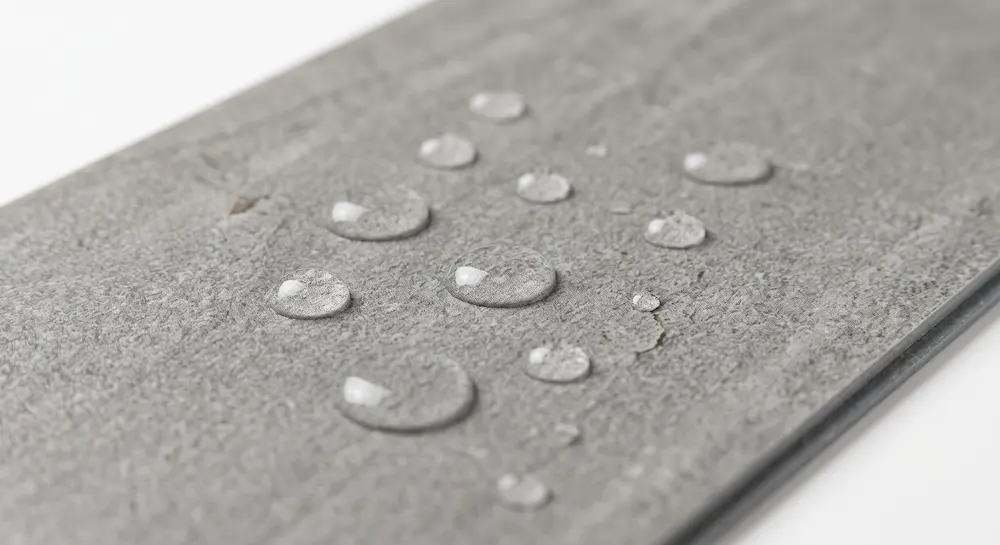
For our SPC Flooring range, the practical implications are straightforward: this is the product we recommend for bathrooms, kitchens, laundry rooms, basement conversions, retail spaces, and any environment where standing water is a realistic risk. It can be installed directly over concrete subfloors, even in below-grade applications where moisture migration through the slab is a concern. The tradeoff is underfoot hardness — the stone-based core is denser than wood alternatives, which some users find less comfortable — and a texture that, however realistic, does not replicate the warmth of genuine natural wood.
Fully Waterproof With Superior Density: MoistureShield 1000
MoistureShield 1000 occupies a specific position in the waterproof flooring landscape: it is a laminate product — in format, installation, and aesthetic — but engineered with a 1000 kg/m³ high-density fiberboard core rather than the 600–800 kg/m³ HDF found in standard laminate. That density difference is not a marketing number. Higher core density means lower porosity, which translates directly to better moisture resistance and dramatically better dimensional stability in humid or variable conditions.
Standard laminate fails in wet environments primarily because its wood-fibre HDF core absorbs ambient moisture and swells — the edge lifting and joint gapping you see in older laminate installations in kitchens or bathrooms is almost always a core moisture issue rather than a surface failure. MoistureShield 1000’s denser core resists this mechanism more effectively than standard laminate, making it a viable specification for kitchens, school classrooms, large commercial spaces, and humid-climate residential applications where the aesthetics of laminate are preferred but standard laminate’s moisture tolerance is insufficient. Explore the full specification at our MoistureShield 1000 product page.
Waterproof Core With Sustainability Credentials: ResinCore
ResinCore is a recycled epoxy resin flooring system engineered from pre-consumer PCB laminate offcuts, bonded with MDI adhesive to produce a non-porous, formaldehyde-free core. The epoxy resin matrix that forms the core is inherently non-hygroscopic — it does not absorb moisture at the molecular level, which is different from a polymer core that is simply dense enough to resist water infiltration. In 24-hour immersion testing, ResinCore showed zero dimensional change, confirming its performance in genuinely wet conditions rather than just high-humidity environments.
For waterproof flooring applications where sustainability documentation is also a specification requirement — healthcare facilities, ESG-reporting institutions, green building certification projects — ResinCore combines full waterproof performance with zero formaldehyde emissions, A2-s1 fire classification, and independently verified recycled content. This makes it one of the few products on the market that can simultaneously satisfy a waterproof specification and a strict indoor air quality requirement without compromise. The full technical documentation is available through our Certificates and Patents page.
Moisture-Resistant but Not Waterproof: Engineered Wood Flooring
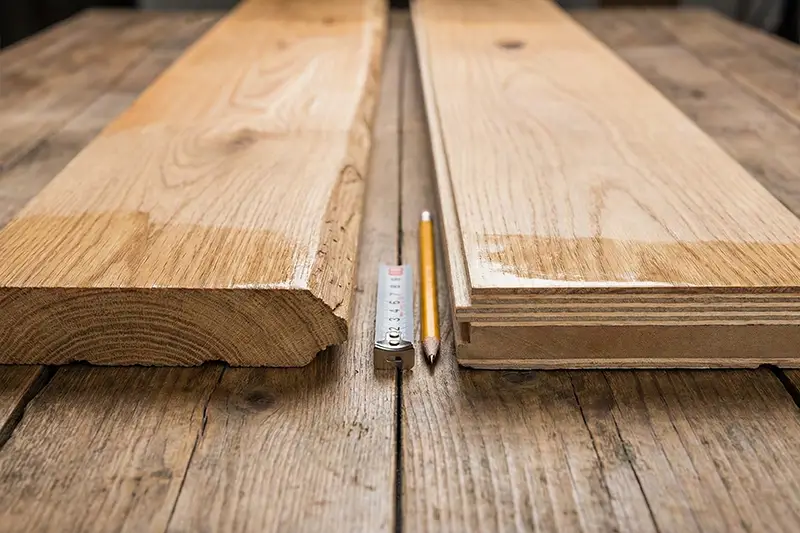
This is where honest disclosure matters most, because engineered wood is frequently marketed with language that implies waterproof performance it does not actually deliver. Engineered wood’s cross-laminated core structure dramatically improves its dimensional stability compared to solid wood — the competing grain directions in adjacent plies resist the cupping and warping that solid wood exhibits under humidity changes. However, the core remains wood-fibre based, which means it will absorb moisture under sustained exposure. Engineered hardwood is moisture resistant, not waterproof — its wood-fibre core will absorb moisture under sustained exposure, leading to swelling, cupping, or joint failure over time.
For our Engineered Wood Flooring, the correct specification position is: excellent for spaces with controlled humidity, compatible with underfloor heating systems (where solid wood would be problematic), and suitable for kitchens and bathrooms only in low-splash configurations with careful maintenance. It is not the right choice for basement applications, high-humidity tropical environments, or spaces where standing water is a regular risk. Buyers who need the aesthetic of real wood in genuinely wet environments should consider our Teak Solid Wood range, whose natural oil content offers better inherent moisture resistance than conventional engineered wood species.
Natural Oil Resistance: Teak Solid Wood Flooring
Teak occupies a unique position among wood flooring options because of its exceptionally high natural oil content. Unlike oak, maple, or other conventional hardwood species used in solid and engineered flooring, Burmese teak contains sufficient natural silica and oil to be genuinely moisture and pest resistant without chemical treatment. This is not a claim that teak is waterproof — prolonged submersion or sustained exposure to standing water will damage any wood flooring, including teak. However, teak’s moisture resistance significantly exceeds that of other hardwood species, making our Teak Solid Wood Flooring a realistic specification for covered outdoor areas, high-end bathrooms with careful management, and humid tropical environments where conventional hardwood would be entirely unsuitable.
The practical implication for specification: teak is the right choice when genuine natural wood aesthetics are non-negotiable and the humidity exposure is moderate rather than extreme. It is not a substitute for SPC or ResinCore in genuinely wet environments, but it performs in moisture-present conditions where no other solid wood species can be responsibly specified.
Water-Resistant Surface, Moisture-Sensitive Core: Laminate Flooring
Standard laminate flooring has a waterproof surface layer — the melamine resin coating that gives it its scratch resistance also prevents water absorption at the surface. The problem is the HDF core, which is wood-fibre based and will absorb moisture that penetrates through the joints between planks, particularly in installations without adequate perimeter sealing. Modern premium laminate products have improved significantly in this regard: Under EN 13329, the European laminate flooring standard, premium products handle spills and splashes well using tight joints and low-swelling core materials — but prolonged exposure to standing water remains a risk for standard HDF cores.
Our Laminate Flooring range is the right specification for dry-to-moderate humidity environments — offices, living rooms, bedrooms, retail spaces without wet processes — where its cost-effectiveness, wide design range, and scratch resistance make it an excellent value proposition. For humid environments or wet rooms, we recommend being honest with clients about the limitations and specifying MoistureShield 1000 or SPC instead. Our detailed comparison at SPC vs Laminate Flooring covers these distinctions in full.
How Every Flooring Type Performs Against Moisture
| Product | Core Type | Water Performance | Humidity Stability | Suitable for Wet Rooms | Suitable for Humid Climates |
|---|---|---|---|---|---|
| SPC Flooring | Limestone + PVC | 100% waterproof | Excellent — <0.05% change | Yes | Yes |
| MoistureShield 1000 | 1000 kg/m³ HDF | Highly resistant | Very good | With care | Yes |
| ResinCore | Recycled epoxy resin | 100% waterproof | Excellent — zero change | Yes | Yes |
| Engineered Wood | Plywood | Moisture resistant | Good | No | With care |
| Teak Solid Wood | Solid Burmese teak | High natural resistance | Good for hardwood | Covered areas only | Yes — better than most hardwood |
| Laminate Flooring | 780-850 kg/m³ HDF | Surface resistant only | Moderate | No | Not recommended |
Which Waterproof Flooring Works Best in Each Room
The right flooring choice for moisture-prone spaces depends not just on a product’s technical performance but on the specific moisture profile of each space. Here is how we approach the room-by-room specification question.
Bathrooms and Wet Rooms
Bathrooms represent the most demanding moisture environment in a residential setting — sustained humidity from showering, risk of standing water, and temperature cycling from hot water use. For bathroom dry zones — the area around the vanity and toilet — SPC and ResinCore are the appropriate specification. For wet zones such as shower areas, ceramic or porcelain tile remains the standard recommendation, as no floating floor system can guarantee a fully watertight joint under sustained direct water exposure. ResinCore is the right choice for bathroom dry zones in healthcare facilities, family homes with young children, or any project where formaldehyde-free indoor air quality is a priority alongside waterproofing. For wet zones, the zero-formaldehyde advantage of ResinCore is best applied in other high-priority spaces such as patient rooms, corridors, and pediatric areas.
Engineered wood and laminate are not appropriate for primary bathroom use. Teak is suitable for covered wet areas — a teak deck around a pool, a covered outdoor shower, or a carefully managed luxury bathroom — but requires more maintenance than synthetic alternatives and should be accompanied by clear client guidance about drying and cleaning protocols.
Kitchens
Kitchens present a different moisture profile from bathrooms: lower absolute humidity but higher risk of localised spills, splashes, and occasional standing water near sinks and dishwashers. SPC remains the most straightforward specification, but MoistureShield 1000 is a strong alternative for buyers who prefer the laminate aesthetic and the kitchen’s moisture exposure is moderate rather than extreme. The key risk with MoistureShield 1000 in kitchens is the area directly in front of the sink and dishwasher — where water pooling is most likely — and appropriate perimeter sealing at those zones is important.
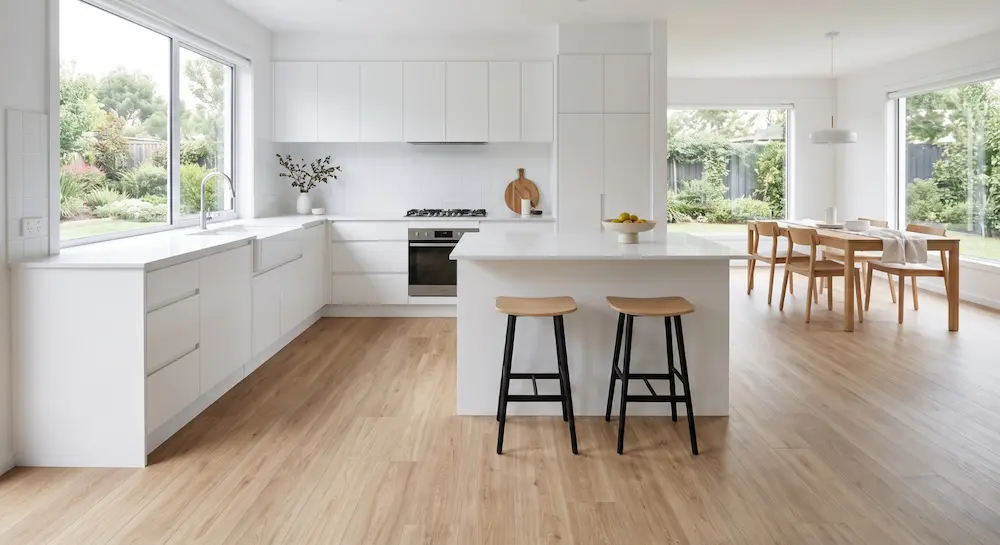
Engineered wood can be used in kitchen-adjacent areas — a dining area opening onto a kitchen, for example — but should not be specified for the kitchen zone itself. Laminate is suitable in similar configurations: the cooking and prep zones should be a different material, while the adjacent dining or living zones can use laminate if the overall project budget requires it.
Basements and Below-Grade Spaces
Basements present the most technically demanding moisture challenge because the risk is not surface water but moisture migration through the concrete slab itself. In climates with significant groundwater pressure or seasonal water table variation, this migration can be substantial enough to cause failure in any flooring system that is not genuinely impervious to ground-up moisture. SPC is the correct specification for below-grade applications precisely because its inorganic core is impervious to moisture from any direction. A floating SPC installation over a concrete basement slab provides a moisture break without the adhesive failure risks of glued-down alternatives.
Children’s playrooms in basement or semi-basement levels represent one of the most compelling waterproof flooring applications in residential projects — spilled drinks, paint, and the general chaos of play make a genuinely waterproof, zero-formaldehyde core like SPC or ResinCore the only responsible specification for families with young children.
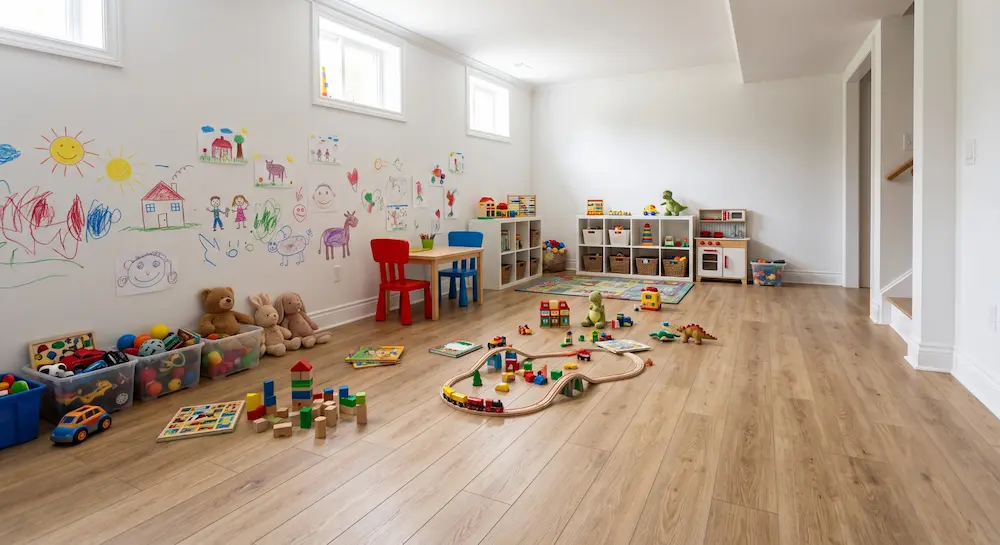
MoistureShield 1000 can perform in basement applications with lower moisture migration risk — a finished basement in a low-water-table environment, for example — but SPC is the safer choice where any doubt exists about moisture conditions. Engineered wood, laminate, and solid wood in any species are not appropriate for below-grade applications.
Humid Climates: Tropical and Coastal Environments
For buyers in Southeast Asia, coastal markets, and tropical climates, the relevant moisture challenge is not liquid water but sustained high ambient humidity — often 80% RH or above for extended periods. This creates a different failure mechanism from surface water exposure: even without any liquid water contact, a moisture-sensitive floor core will absorb ambient humidity and expand, leading to buckling, gapping, or cupping over time. SPC and ResinCore are both appropriate for tropical and coastal applications because their inorganic cores are genuinely non-hygroscopic — they do not respond to ambient humidity changes regardless of duration. MoistureShield 1000’s denser HDF core also performs better than standard laminate in these conditions, though not as robustly as mineral-core alternatives.
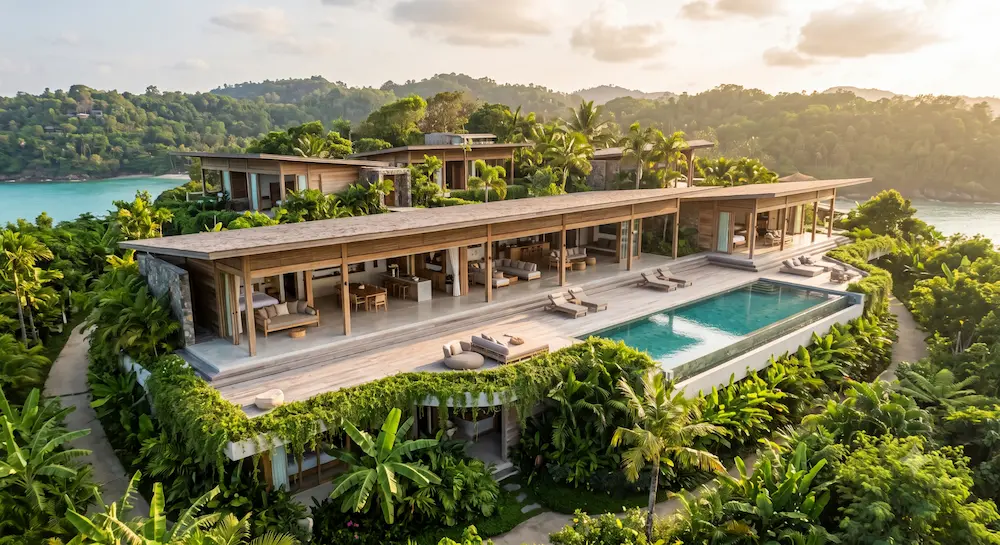
Teak is the notable exception among wood products: its natural oil and silica content give it humidity tolerance that other hardwood species cannot match, which is why teak has historically been the wood of choice for marine and tropical applications. Our comparison of solid wood vs engineered wood covers the humidity performance differences between wood species and construction types in detail.
Waterproof Flooring Claims: What to Verify Before You Specify
The moisture-resistance category has a well-documented problem with marketing language that overstates performance. Here is what to verify before accepting a waterproof claim at face value.
Surface vs Core: The Most Important Distinction
Almost every flooring product sold today has a waterproof surface layer. The melamine resin on laminate, the UV coating on SPC, the lacquer on engineered wood — all of these prevent surface water absorption. The performance difference lies entirely in what happens when water penetrates the joints between planks, which it will do in any floating floor installation under prolonged exposure. A product with a waterproof surface and a moisture-sensitive core — standard laminate being the clearest example — will fail not at the surface but at the joints, where water reaches the core and causes swelling. A product with a waterproof core — SPC, ResinCore — will not fail regardless of how long water sits at the joint, because there is nothing in the core to absorb.
What Independent Test Reports Should Show
When evaluating a moisture-resistance claim, ask for the actual test report rather than a general certification reference. The relevant tests are EN 13329 for laminate (which includes a moisture swelling test measuring core expansion after immersion), ISO 24346 for resilient flooring dimensional stability, and ASTM F3261 for waterproof core verification. The US EPA’s indoor air quality guidance also notes that moisture in flooring systems is a primary driver of mould growth, reinforcing why core waterproofing matters beyond just the floor surface itself. A supplier who cannot provide a specific report with measured values — not just a pass/fail declaration — is not giving you enough information to make a defensible specification decision. At Karlyn Floors, we hold current Intertek and SGS test reports for our full product range, available through our Certificates and Patents page.
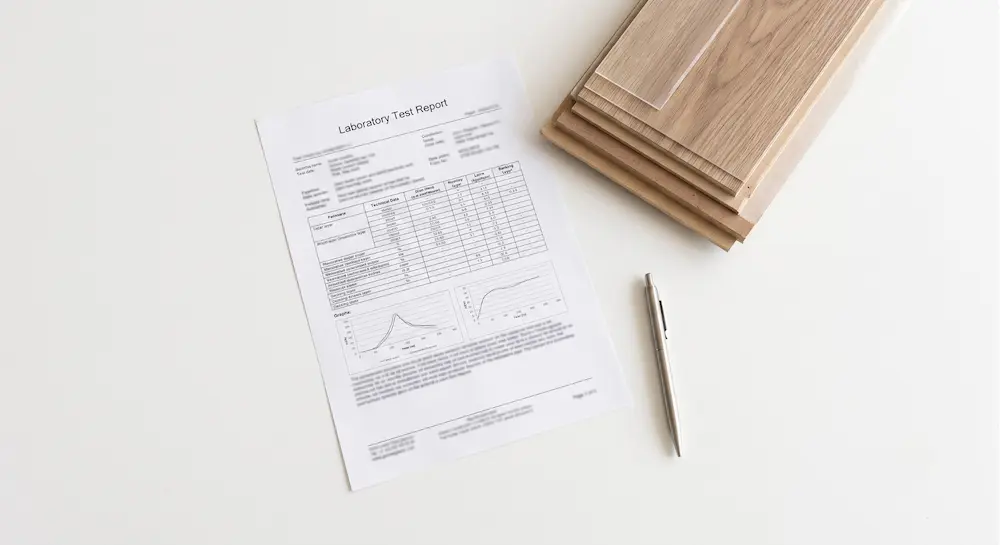
| Standard | What It Tests | Most Relevant For |
|---|---|---|
| EN 13329 | Laminate moisture swelling — core expansion after 24hr immersion | Laminate, MoistureShield 1000 |
| ISO 24346 | Resilient flooring dimensional stability under temperature and humidity | SPC, ResinCore |
| ASTM F3261 | Waterproof core verification for rigid core flooring | SPC, ResinCore |
| EN ISO 717-2 | Impact sound insulation — relevant when acoustic underlay is part of the spec | All floating floor products |
Installation Factors That Affect Waterproof Performance
A waterproof floor specified correctly can fail if installed incorrectly. Three installation factors directly affect the real-world waterproof performance of any floating floor system.
Perimeter Sealing and Expansion Gaps
All floating floor systems require an expansion gap around the perimeter to allow for thermal movement. A standard dry-room installation covers this gap with skirting board and presents no problem. However, wet rooms and high-humidity environments turn this perimeter gap into a potential water ingress point — if water runs along the wall and finds the gap, it can reach the subfloor and, in the case of wood-fibre cores, cause swelling at the edges before working inward. For bathroom and kitchen applications, the perimeter gap should be sealed with a flexible silicone bead before skirting is installed, creating a continuous waterproof barrier at the junction between floor and wall. This applies even to fully waterproof core products like SPC — the floor itself will not fail, but unmanaged water reaching the subfloor creates its own problems.
Subfloor Flatness and Moisture Conditions
Floor performance is only as good as the subfloor it sits on. A concrete subfloor with residual moisture content above 75% relative humidity (measured by hygrometer probe) will continue to release moisture upward after installation, which can create problems even for waterproof core products if the moisture has nowhere to go. The standard recommendation for concrete subfloors in wet applications is to allow adequate curing time, treat with a moisture barrier if residual moisture is present, and verify flatness within 3mm over 1800mm before installation. These requirements apply equally to SPC, ResinCore, and MoistureShield 1000 — waterproof core does not substitute for correct subfloor preparation.
Joint Integrity and Locking System Quality
The click-lock locking system that connects individual planks is the most critical waterproof performance variable in any floating floor installation. A tight, well-manufactured locking profile minimises the joint gap through which water can penetrate, while a loose or poorly manufactured system creates openings that accelerate water ingress. When evaluating a waterproof flooring product, ask specifically about the locking system tolerance and whether the manufacturer provides test data on joint tightness under immersion. Products with certified locking systems — such as the Välinge 2G/2G profile used in several of our products — provide measurably better joint integrity than generic click profiles.
Frequently Asked Questions About Moisture and Flooring
Is SPC flooring truly 100% waterproof or is that a marketing claim?
SPC flooring is genuinely 100% waterproof at the core level — the limestone and PVC composite that forms the structural core of SPC cannot absorb water regardless of exposure duration. This is not a surface treatment or a coating that can wear off. Independent ISO testing consistently confirms less than 0.05% dimensional change under prolonged immersion for rigid core flooring products. The caveat is installation: even a waterproof core floor can allow water to reach the subfloor through perimeter gaps if those gaps are not properly sealed. Correct perimeter silicone sealing closes that vulnerability and makes SPC a reliable specification for bathroom dry zones, kitchens, and basements. For shower wet zones, ceramic or porcelain tile remains the standard recommendation.
Can I use engineered wood flooring in a bathroom?
Not in a standard bathroom configuration. Engineered wood’s cross-laminated core resists humidity-driven movement better than solid wood, but it is not waterproof — sustained moisture exposure, steam, and the risk of standing water in a bathroom will eventually cause core moisture absorption, joint swelling, and surface problems. The only wood-based product we would consider for bathroom applications is teak solid wood in carefully managed, low-splash configurations — such as a luxury bathroom where ventilation is excellent and surface drying is diligent. For most bathroom specifications, SPC or ResinCore is the appropriate recommendation.
What is the difference between MoistureShield 1000 and standard laminate for humid environments?
The core difference is density. Standard laminate uses HDF cores at 780-850 kg/m³, which have relatively high porosity and will absorb ambient moisture in sustained high-humidity environments, leading to edge swelling and joint failure over time. MoistureShield 1000 uses a 1000 kg/m³ HDF core — significantly denser and less porous — which resists the moisture absorption mechanism that causes standard laminate to fail in humid conditions. The result is a product that can be specified for kitchens, school classrooms, and humid-climate commercial spaces where standard laminate would not be appropriate, while maintaining the laminate aesthetic and installation format that many buyers prefer. It is not a substitute for SPC in genuinely wet room applications, but it extends laminate’s viable specification range significantly.
Is waterproof flooring suitable for underfloor heating?
It depends on the product. SPC flooring is compatible with underfloor heating systems because its inorganic core is not affected by the temperature cycling that UFH produces. ResinCore similarly performs well with underfloor heating given its non-hygroscopic epoxy core. Our Engineered Wood Flooring is specifically designed for UFH compatibility, with its cross-laminated core resisting the dimensional changes that temperature cycling would cause in solid wood. Standard laminate, including MoistureShield 1000, can be used with UFH within specified temperature limits — typically a maximum surface temperature of 27°C — but requires careful system design to stay within those limits. Teak solid wood is not recommended for underfloor heating due to its dimensional movement characteristics. Our guide on solid wood vs engineered wood covers the UFH compatibility question in detail.
How do I know which waterproof flooring is right for my specific project?
The most reliable starting point is to characterise the moisture profile of your space accurately before choosing a product: is the moisture risk from liquid water (spills, splashes, standing water), from ambient humidity (tropical climate, coastal location, basement), or from both? Liquid water risk points toward SPC or ResinCore. Ambient humidity risk can be addressed by SPC, ResinCore, or MoistureShield 1000 depending on severity. Where genuine natural wood aesthetics are required alongside moisture performance, teak is the only solid wood species we would confidently specify. For project-specific guidance, our team is available through our Contact page to discuss the moisture conditions of your space and recommend the appropriate product from our range.
The Bottom Line: Matching Waterproof Performance to Real-World Conditions
Choosing the right waterproof flooring is not about finding the product with the most confident waterproof claim — it is about matching a product’s genuine technical performance to the specific moisture conditions of your space. SPC and ResinCore deliver true core-level waterproofing suitable for the most demanding wet and humid environments. MoistureShield 1000 extends laminate’s viable specification range into moderate-humidity applications where standard laminate would fail. Engineered wood and teak offer meaningful moisture resistance within the natural wood category, with important limitations that honest specification requires acknowledging. Standard laminate performs well in dry to moderate conditions and should not be specified where sustained moisture exposure is a realistic risk.
The common thread across all these flooring decisions is verification: ask for the actual test report, not just the certification reference. Understand whether a waterproof claim applies to the surface, the core, or both. And factor in installation quality — even the most technically advanced floor will underperform if perimeter sealing, subfloor preparation, and locking system integrity are not addressed correctly.
If you are evaluating waterproof flooring for a specific project and want to discuss the moisture profile of your space against the performance characteristics of our product range, reach out through our Contact page or explore our products at karlynfloors.com.