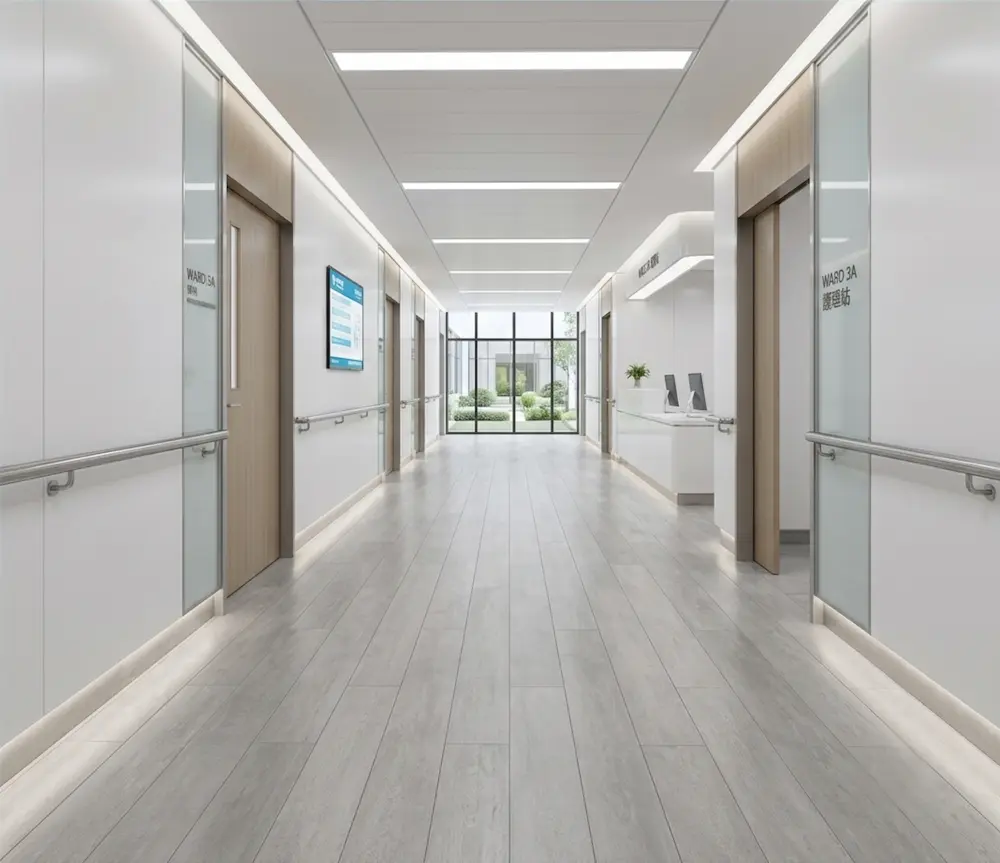

Moisture resistant laminate flooring exists because standard laminate has a moisture problem — and the industry has known about it for decades. The HDF core that gives laminate its rigidity and click-lock precision is also the component that fails when moisture enters the system — whether from a kitchen spill, a subfloor with inadequate vapour barriers, or simply the ambient humidity of a coastal or tropical climate. Once the core absorbs moisture, it swells irreversibly. Joints gap. Edges lift. The floor is ruined, and there is no repair short of replacement.
For years, the standard advice was simple: if moisture is a concern, do not use laminate. Use SPC or tile instead. That advice was correct for standard 600 to 800 kg/m³ density HDF cores. But a new category of moisture resistant laminate flooring built on 1000 kg/m³ HDF cores has changed the equation. Not by making laminate waterproof — it is not — but by raising the density high enough to dramatically slow moisture absorption, giving these products genuine viability in environments where standard laminate would fail within months.
I have been distributing flooring across Asia, Europe, and the Middle East for over thirty years, and the most common flooring failure I see in the field is standard laminate that was installed in the wrong environment. This article explains where moisture resistant laminate flooring fits, where it does not, and how to specify it correctly so you avoid becoming another cautionary tale. All performance claims should be verified against recognized testing standards — products carrying FloorScore certification have been independently tested for both indoor air quality and moisture performance.
The Problem with Standard Laminate in Humid Environments
How HDF Cores Absorb Moisture
Understanding why standard laminate fails in moisture starts with understanding what HDF is. High-density fiberboard is made from wood fibres compressed under heat and pressure with resin binders. As with all wood-fibre composite products, formaldehyde emissions from the resin system are a specification concern — products should comply with CARB Phase II emission standards or EN 717-1 E0 requirements regardless of core density. The resulting board is dense, rigid, and excellent at supporting a click-lock installation system. But wood fibres are inherently hygroscopic — they absorb moisture from the surrounding environment at the molecular level, regardless of whether liquid water is present at the surface.
In a standard HDF core at 600 to 800 kg/m³, the fibre structure has enough porosity to absorb ambient moisture over time. In consistently humid environments — anything above 60 percent relative humidity sustained over weeks — the core gradually takes on moisture, expanding as it does. This expansion is not uniform: it concentrates at the edges and joints where the fibre ends are most exposed, causing the characteristic edge swelling and joint lifting that every flooring professional has seen in a failed laminate installation.
Where Standard Laminate Consistently Fails
The failure pattern is predictable. Kitchens, where water splashes around sinks and dishwashers. Basements and ground-floor slab-on-grade installations, where subfloor moisture vapour migrates upward through the concrete. Coastal and tropical climate projects, where ambient humidity regularly exceeds 65 percent RH. Laundry adjacencies, where moisture migrates through walls and doorways. In every case, the failure mechanism is the same: moisture reaches the HDF core, the core swells, and the floor system fails. The European Producers of Laminate Flooring (EPLF) acknowledges this directly — their specifications explicitly exclude areas subjected to frequent wetting, including bathrooms, laundry rooms, and saunas. For a broader comparison of how laminate stacks up against waterproof alternatives, our waterproof flooring guide covers the full spectrum of options.
What Makes Moisture Resistant Laminate Flooring Different

The principle behind moisture resistant laminate flooring is straightforward: increase the HDF core density until the porosity drops low enough to meaningfully resist moisture absorption. At 1000 kg/m³, the wood fibres are compressed to a point where the remaining pore structure is substantially smaller and less interconnected than in a standard 600 to 800 kg/m³ core. The result is not waterproofing — water will still damage any HDF core given enough time and exposure — but a dramatic reduction in the rate and extent of moisture uptake under real-world conditions.
| Property | Standard Laminate (600–800 kg/m³) | MoistureShield 1000 (1000 kg/m³) |
|---|---|---|
| Core Density | 600–800 kg/m³ | 1000 kg/m³ |
| Moisture Absorption Rate | Higher — porous fibre structure | Significantly lower — compressed fibre structure |
| Edge Swelling Risk | High in humid environments | Low under normal conditions |
| Dimensional Stability | Moderate — vulnerable above 60% RH | High — stable in variable humidity |
| Suitable Climates | Consistently air-conditioned interiors only | Variable humidity including coastal and tropical |
| Kitchen Use | Not recommended | Suitable with prompt spill cleanup |
| Bathroom Use | No | No — not waterproof, use SPC or tile |
| Price Range | $15–$35/m² | $25–$45/m² |
The price premium for 1000 kg/m³ density over standard laminate is typically 30 to 50 percent on material cost. That sounds significant until you compare it to the cost of a full floor replacement when standard laminate fails in a humid environment eighteen months after installation — a scenario I have seen more times than I care to count.
MoistureShield 1000: Product Specifications
For projects that require moisture resistant laminate flooring with verified commercial-grade performance, our MoistureShield 1000 is engineered specifically for environments where standard laminate cannot perform reliably. The product specifications reflect the design priorities: moisture resistance, dimensional stability, and commercial-grade durability.
| Specification | MoistureShield 1000 |
|---|---|
| Core Material | HDF at 1000 kg/m³ |
| Available Sizes (L×W mm) | 1800×238, 1500×238, 1200×238, 900×238, 600×238 |
| Wear Layer | AC4 / AC5 |
| Surface | EIR — Embossed in Register |
| Installation | Click-lock floating system |
| Suitable Applications | Kitchens, basements, classrooms, large commercial spaces, rental properties, coastal climate projects |
| Certifications | CE, ISO 9001 |
| Customisation | Available — two-month sample lead time |
The size range from 600mm to 1800mm in length gives specifiers flexibility across different project scales and aesthetic requirements. The 1800×238mm format works for large commercial installations where fewer joints mean both a cleaner visual and fewer potential moisture entry points. The 600×238mm format suits smaller spaces and areas where cut waste needs to be minimised. All sizes share the same 1000 kg/m³ core density and click-lock installation system.
Where Moisture Resistant Laminate Flooring Fits — and Where It Does Not
Kitchens and Dining Areas
Kitchens are the most common environment where standard laminate fails and where moisture resistant laminate flooring makes the most practical difference. Water splashes around sinks, dishwashers occasionally leak, and spills are a daily occurrence. Standard laminate in a kitchen is a ticking clock. MoistureShield 1000 handles the intermittent moisture exposure that defines kitchen use — splashes, spills, damp mopping — without the edge swelling that would destroy a standard laminate floor within a year. The critical qualifier is prompt spill cleanup. A 1000 kg/m³ core resists moisture absorption, but it is not waterproof. Standing water left for hours will eventually penetrate any HDF-based product.
Basements and Ground-Floor Installations
Slab-on-grade and below-grade installations present a specific moisture challenge: vapour transmission through the concrete subfloor. Even with vapour barriers, some moisture migration is inevitable in many climates. Standard laminate installed on a concrete slab in a humid climate will often show edge swelling within six to twelve months, even without any surface water exposure. The denser core of moisture resistant laminate flooring provides a significantly wider margin of tolerance for subfloor moisture vapour, making it viable for basement and ground-floor applications where standard laminate would be excluded from specification. Proper vapour barrier installation under the underlay remains essential — the high-density core supplements this protection but does not replace it.
Coastal and Tropical Climate Projects

This is where core density matters most. In Southeast Asia, the Middle East, coastal Australia, and tropical regions globally, ambient humidity regularly exceeds 65 percent RH — sometimes sustained above 80 percent during monsoon seasons. Standard laminate is simply not an option in these environments. Our SPC flooring remains the first recommendation for projects in consistently humid climates because it is completely waterproof and unaffected by humidity at any level. But for projects where the interior environment is air-conditioned and maintained below 60 percent RH — hotel guest rooms, office interiors, air-conditioned retail — MoistureShield 1000 provides a cost-effective alternative that delivers the aesthetic range and scratch resistance of laminate with the moisture resilience needed to survive in tropical markets.
Where It Does Not Fit
Bathrooms, wet rooms, outdoor applications, and any area with standing water or direct water exposure. No HDF-based product, regardless of core density, should be specified for these environments. The moisture resistance of a 1000 kg/m³ core extends the range of environments where laminate can perform reliably, but it does not turn laminate into a waterproof material. For genuinely wet zones, specify SPC flooring or porcelain tile. This distinction matters because overpromising on moisture performance is how laminate failures happen — and a 1000 kg/m³ core fails just as permanently as a 600 kg/m³ core when it is installed in a bathroom. It just takes longer.
Moisture Resistant Laminate Flooring vs SPC
The natural question when evaluating moisture resistant laminate flooring is whether you should just use SPC instead. The answer depends on what you are optimising for.
SPC is fully waterproof and handles any moisture environment without risk. It is the safer choice for any project where moisture exposure is unpredictable or severe. But SPC has trade-offs: the surface feels harder underfoot, the range of decorative patterns is narrower than laminate, and the material is heavier to transport and handle during installation. The North American Laminate Flooring Association (NALFA) maintains independent certification programs that verify laminate product performance claims, providing an additional layer of due diligence for specifiers evaluating laminate versus alternative materials. For a detailed comparison of SPC and standard laminate across all performance criteria, see our SPC vs laminate flooring guide.
MoistureShield 1000 occupies the middle ground. It gives you laminate’s wider aesthetic range, lighter weight, and warmer surface feel, with moisture resistance that covers the vast majority of indoor commercial and residential applications short of direct water exposure. For projects where budget matters and the environment is managed but not perfectly controlled — rental apartments in coastal cities, school classrooms in humid regions, hotel corridors in tropical markets — this middle ground is exactly where many specifications land. For a broader view of how laminate technology is evolving, our 2026 laminate flooring trends article covers the market direction in detail.
Frequently Asked Questions
Is MoistureShield 1000 waterproof?
No. It is moisture resistant, not waterproof. The 1000 kg/m³ HDF core absorbs moisture at a dramatically lower rate than standard 600 to 800 kg/m³ cores, which means it can handle kitchen splashes, humidity fluctuations, and damp mopping without the edge swelling that destroys standard laminate. But it will still be damaged by standing water left for extended periods. For waterproof requirements, SPC flooring or porcelain tile is the correct specification.
Can I install it in a bathroom?
No. Bathrooms involve sustained direct water exposure — shower overspray, bath splashes, condensation — that will eventually damage any HDF-based flooring product regardless of core density. For bathroom dry areas immediately adjacent to wet zones, it can work with appropriate transition strips and waterproofing at the threshold. But inside the bathroom itself, use SPC or tile.
How does the cost compare to SPC?
MoistureShield 1000 typically costs $25 to $45 per square metre, positioning it between standard laminate ($15 to $35/m²) and SPC ($30 to $60/m²). The cost advantage over SPC is most significant in large-area commercial installations where the price difference per square metre multiplies across thousands of square metres. For smaller residential projects, the cost gap narrows and SPC’s full waterproofing may justify the premium.
What AC rating does MoistureShield 1000 carry?
AC4 and AC5, depending on the specific product within the range. AC4 is rated for general commercial use, while AC5 handles heavy commercial traffic — hotel corridors, retail stores, school classrooms. The AC rating measures surface abrasion resistance under the EN 13329 testing standard and is independent of the core density. Both standard laminate and MoistureShield 1000 can carry AC5 ratings; the difference is in moisture performance, not surface durability.
Does Karlyn Floors offer custom patterns and sizes?
Yes. MoistureShield 1000 is available in five length formats from 600mm to 1800mm, and custom colour and pattern options are available with a two-month sample preparation lead time. All products come with CE and ISO 9001 certification, full origin documentation, and are available for inspection at our certifications page. For specification support or sample requests, contact our team directly.
Conclusion: Moisture Resistance Is Not Waterproofing, and That Is the Point
The value of moisture resistant laminate flooring is not that it replaces SPC or tile in wet environments. It is that it expands the range of environments where laminate — with all its advantages in aesthetics, scratch resistance, and cost — can be specified with confidence. Standard laminate at 600 to 800 kg/m³ is a perfectly good product in consistently dry, climate-controlled interiors. But the world has a lot of kitchens, basements, coastal cities, and tropical climates where that performance envelope is too narrow. MoistureShield 1000 at 1000 kg/m³ widens it meaningfully, without pretending to be something it is not.
If you are specifying laminate for a project where moisture is a known variable — not a dominant condition, but a realistic one — this product category deserves serious evaluation. The cost premium over standard laminate is modest. The cost of replacing a failed standard laminate floor is not.