I have been in the flooring business long enough to know that the word “durable” is one of the most abused terms in our industry. Every product brochure uses it. Almost none of them define it. And when a wear-resistant flooring product fails six years into what was supposed to be a twenty-year lifecycle, the word “durable” quietly disappears from the conversation.
Wear resistance is not vague. It is measurable, testable, and directly linked to specific material properties that either hold up under real-world traffic or do not. This guide cuts through the marketing language and explains what wear-resistant flooring actually means — how it is rated, which materials genuinely deliver, where each option has limits, and how to match the right surface to the right space before you commit a budget to it.
If you are specifying for a hotel lobby, a school corridor, a retail floor, or a commercial office, this is the framework that will keep you from making an expensive mistake.
What “Wear-Resistant Flooring” Actually Means
Wear resistance is the capacity of a floor surface to resist degradation from friction, abrasion, and impact over time. It is not the same as hardness, though hardness contributes to it. It is not the same as durability, which is a broader concept that includes structural integrity, dimensional stability, and resistance to moisture and chemical damage. Wear resistance refers specifically to surface degradation — scratching, scuffing, dulling, and the gradual loss of the decorative or protective layer.
In commercial flooring, surface wear is driven by three primary forces: foot traffic abrasion from shoe soles and grit particles, rolling loads from castors and wheeled equipment, and cleaning abrasion from repeated mopping and machine cleaning. Each of these operates differently. Foot traffic distributes force over a large area. Rolling loads concentrate force on a small contact point and generate abrasion rates that dwarf equivalent hours of foot traffic. Cleaning abrasion is cumulative and chemical — the wrong cleaning product strips protective finishes faster than years of foot traffic ever would.
Understanding which forces your specific project will encounter is the starting point for any intelligent wear-resistant flooring specification. A retail store primarily sees foot traffic and occasional pallet jack loads. A school corridor sees foot traffic, cleaning machine abrasion, and the specific damage pattern of students dragging furniture. A hotel lobby sees foot traffic, luggage wheel loads, and the intense pressure of first impressions that cannot afford visible wear after two years of operation.
The AC Rating System: The Industry Standard for Laminate Wear Resistance
For laminate flooring, the North American Laminate Flooring Association (NALFA) and the European EN 13329 standard both use the Abrasion Class (AC) rating system to classify surface wear resistance. The scale runs from AC1 to AC6, with each level corresponding to a tested number of revolutions in the Taber abrasion test before the decorative layer is worn through.
| AC Rating | Classification | Typical Use Case | Minimum IP (Taber Revolutions) |
|---|---|---|---|
| AC1 | Low residential traffic | Bedrooms, closets | 500+ |
| AC2 | Moderate residential traffic | Living rooms, dining rooms | 1,000+ |
| AC3 | Heavy residential / light commercial | Corridors, home offices | 2,000+ |
| AC4 | Moderate commercial | Shops, cafés, offices | 4,000+ |
| AC5 | Heavy commercial | Department stores, public buildings | 6,000+ |
| AC6 | Very heavy commercial | Airport terminals, exhibition halls | 8,500+ |
The practical implication of this scale is straightforward: do not specify AC3 laminate for a commercial project. AC4 is the minimum for any public-facing commercial space. AC5 is appropriate for school corridors, high-footfall retail, and hotel public areas. The AC rating tells you about surface abrasion resistance — it does not tell you about core stability, moisture resistance, or resistance to rolling loads, which is why it is a starting point for specification, not a complete answer.
Wear Layers in SPC Flooring: The Thickness That Actually Matters
For SPC flooring, the equivalent metric to the AC rating is wear layer thickness, measured in millimetres. The wear layer is the transparent protective coating applied over the decorative film, and its thickness determines how long the surface resists scuffing and abrasion before the decorative layer becomes visible and damaged.
SPC wear layers in commercial products come in two practical specifications: 0.3mm for residential use and 0.5mm for commercial applications. In our experience at Karlyn Floors, a 0.5mm wear layer is sufficient for virtually all commercial environments — from general retail and offices through to hotel corridors and school common areas. Products certified under the FloorScore program will have their wear layer specification independently verified as part of the certification process, which adds a meaningful layer of confidence to the stated thickness claim.
Material-by-Material Comparison: Which Floors Are Genuinely Wear-Resistant
Not all wear-resistant flooring performs the same way. Each material category has a different wear mechanism, a different failure mode, and a different profile of environments where it performs well versus where it struggles. Understanding these differences is essential before making a specification decision.
SPC Flooring: The Benchmark for Commercial Wear Resistance
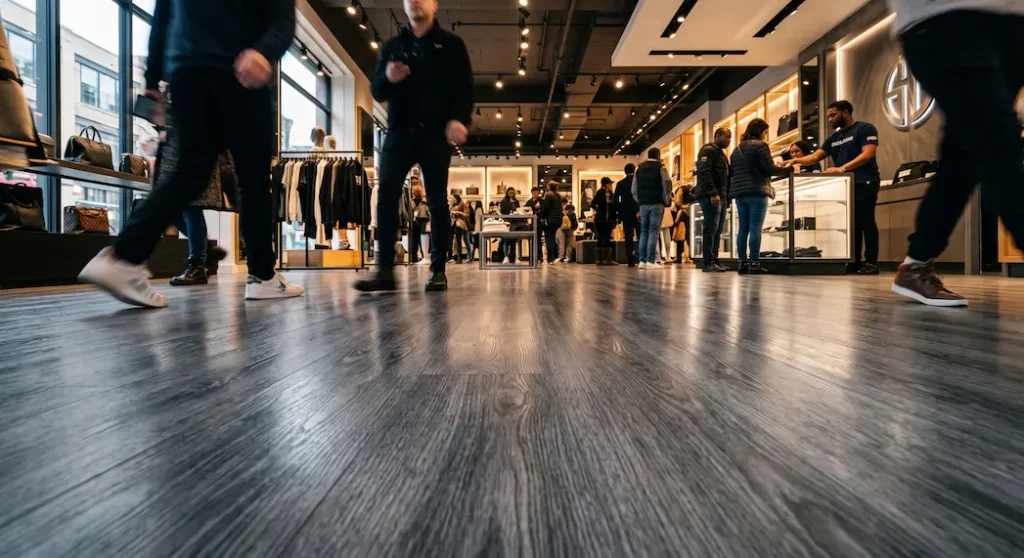
SPC — Stone Plastic Composite — is currently the most popular wear-resistant flooring specification for commercial projects, and the popularity is justified. The stone powder and PVC core provides dimensional stability that most other materials cannot match: it does not expand or contract significantly with temperature or humidity changes, which means it maintains its surface integrity in environments where wood and HDF-based products would fail. The rigid core distributes impact and rolling loads more effectively than flexible vinyl, reducing the surface indentation that becomes visible wear over time.
In terms of surface wear resistance, SPC products with a 0.5mm wear layer typically deliver ten to fifteen years in commercial office and retail environments. Heavier-traffic zones — hotel lobbies, school corridors, high-footfall retail — will see seven to twelve years from the same specification. The SPC flooring range we supply at Karlyn Floors includes 0.3mm and 0.5mm wear layer options across multiple size formats, allowing specification to be matched to the actual traffic intensity of each zone rather than applying a single product across an entire project.
The key limitation of SPC as wear-resistant flooring is that it cannot be refinished. When the wear layer is consumed, the floor needs replacing. This makes wear layer thickness a critical procurement decision rather than a minor specification detail — the difference between 0.3mm and 0.5mm is not simply 0.2mm of extra protection. In a busy commercial environment, that difference can represent several additional years of service life.
High-Density Laminate: Surface Wear Resistance With Improved Moisture Tolerance
Standard laminate’s reputation for wear resistance is deserved at the surface level — AC4 and AC5 laminate genuinely resists abrasion at rates that compete with many SPC products. The problem is that laminate’s HDF core absorbs moisture at the joints, and moisture absorption causes swelling that destroys the floor structurally before the surface ever wears out. In a dry, consistently climate-controlled environment, standard laminate is an excellent wear-resistant flooring choice. In the real world — where kitchens get splashed, cleaning crews mop aggressively, and humidity fluctuates between seasons — the moisture vulnerability shortens laminate floors’ lives well before their AC-rated surface is consumed.
MoistureShield 1000, our 1000 kg/m³ high-density laminate, addresses this directly. The higher core density significantly reduces moisture absorption compared to standard laminate at 600–800 kg/m³, which means the structural integrity of the floor is maintained in environments where standard laminate would swell and fail. Combined with AC4 surface wear resistance, this product delivers a durability profile that suits large-area commercial projects where both surface performance and core stability matter.
Engineered Wood: Wear Resistance With a Refinishing Advantage
Engineered wood’s wear resistance story is more nuanced than SPC or laminate because the material can be refinished — but only if the veneer is thick enough to survive sanding. A solid engineered wood flooring specification with a 3mm or thicker hardwood veneer can be refinished one to two times over its service life, effectively resetting the wear clock each time. This gives engineered wood a lifecycle advantage in the wear-resistance calculation that its year-by-year surface performance does not fully capture.
In commercial applications, engineered wood is most appropriate where aesthetic requirements are high and traffic loads are moderate — boutique hotel guestrooms, corporate executive floors, high-end retail where the floor is part of the brand experience. In heavy-traffic zones like corridors, lobbies, and food service areas, the rolling load and cleaning abrasion profile makes SPC or high-density laminate a more reliable wear-resistant flooring choice.
Teak Solid Wood: Natural Wear Resistance for Premium Long-Term Installations
Teak’s natural oil content gives it a surface hardness and moisture resistance that no manufactured product replicates. The natural silica content of teak also provides an inherent scratch resistance that contributes to its legendary durability. As wear-resistant flooring, teak flooring performs best in premium hospitality and high-end residential applications — hotel suites, private villas, and executive spaces — where the floor is a long-term investment expected to last decades with periodic refinishing. Teak develops a rich patina over time, meaning it tends to look better with age rather than simply worn.
For general commercial environments with heavy daily foot traffic and aggressive cleaning regimes, teak is rarely the practical first choice. Its strength lies in spaces where the ownership horizon is long, aesthetic longevity matters, and the maintenance discipline to support periodic refinishing is in place. Our flooring lifespan comparison breaks down the cost-per-year calculation across all material categories for projects where teak is under consideration.
How to Read a Wear Rating: What the Numbers Tell You and What They Don’t
Wear ratings — whether AC class or wear layer thickness — are measured under controlled laboratory conditions designed to produce consistent, comparable results. This is their strength and their limitation simultaneously. The laboratory does not contain grit-laden shoe soles dragged across the surface every morning. It does not contain the concentrated rolling load of a hotel luggage trolley. It does not contain the alkaline cleaning solution that strips protective finishes three times faster than the test apparatus ever could.
The Taber abrasion test used for AC classification uses standardised abrasive wheels, a fixed load, and a fixed number of rotations. It measures one type of abrasion under one set of conditions. Real-world wear is more complex — it is the combined effect of multiple abrasion mechanisms operating simultaneously over years, not a single mechanical test run for an afternoon.
This does not mean wear ratings are useless. They are genuinely useful for comparing products within the same category on a consistent basis. An AC5 laminate will outperform an AC3 laminate in abrasion resistance, and that relationship holds in the field. A 0.5mm SPC wear layer will outlast a 0.3mm wear layer in commercial use, consistently. The ratings are reliable for relative comparisons within categories. They are less reliable for absolute predictions of service life or for comparing fundamentally different material categories against each other.
The ISO 4918 castor chair test is a more useful reference point for office flooring specifications because it directly tests the rolling load scenario that is the primary wear driver in office environments. Products that cite ISO 4918 compliance have been tested under a force pattern that actually reflects how offices use floors, making the result more predictive of real-world performance than Taber abrasion data alone.
Wear Resistance by Space Type: A Zone-by-Zone Framework
Different commercial spaces impose different wear patterns, and the right wear-resistant flooring specification varies significantly across project types and zones within those projects. The table below summarises the primary wear drivers and minimum specification benchmarks for the most common commercial scenarios.
| Space Type | Primary Wear Driver | Minimum Specification | Recommended Material |
|---|---|---|---|
| Hotel lobby | Foot traffic + luggage wheels | AC5 or SPC 0.5mm wear layer | SPC or teak |
| Hotel guestroom | Moderate foot traffic, light furniture | AC4 or SPC 0.3mm wear layer | Engineered wood or SPC |
| School corridor | Heavy foot traffic + furniture dragging | AC5 or SPC 0.5mm wear layer | SPC |
| School classroom | Foot traffic + castor chairs + daily mopping | SPC 0.5mm wear layer | SPC — fully waterproof and cost-effective |
| Office open plan | Rolling chair castors | ISO 4918 compliant, AC4 minimum | SPC or engineered wood with chair mats |
| Retail store | Foot traffic + display furniture loads | AC4 or SPC 0.5mm wear layer | SPC or MoistureShield 1000 |
| Restaurant | Foot traffic + spills + cleaning abrasion | SPC 0.5mm wear layer | SPC — waterproof core essential |
| Residential living room | Light foot traffic | AC3 or above | Engineered wood, laminate, or SPC |
School classrooms deserve a specific note. Daily wet mopping in an education environment creates consistent moisture exposure at the floor level that makes a fully waterproof core the safest long-term specification. SPC is the straightforward choice here — it is waterproof, cost-effective, and available in formats that suit large-area school projects. For further detail on school project specification, our school flooring guide covers acoustic, safety, and durability requirements zone by zone.
Installation Factors That Affect Wear Resistance in Practice
Even the best-specified wear-resistant flooring underperforms if the installation is wrong. The surface is only as good as what is underneath it, and the two installation factors that most consistently degrade wear performance are subfloor preparation and expansion gap management.
Subfloor Levelling and Its Direct Impact on Surface Wear
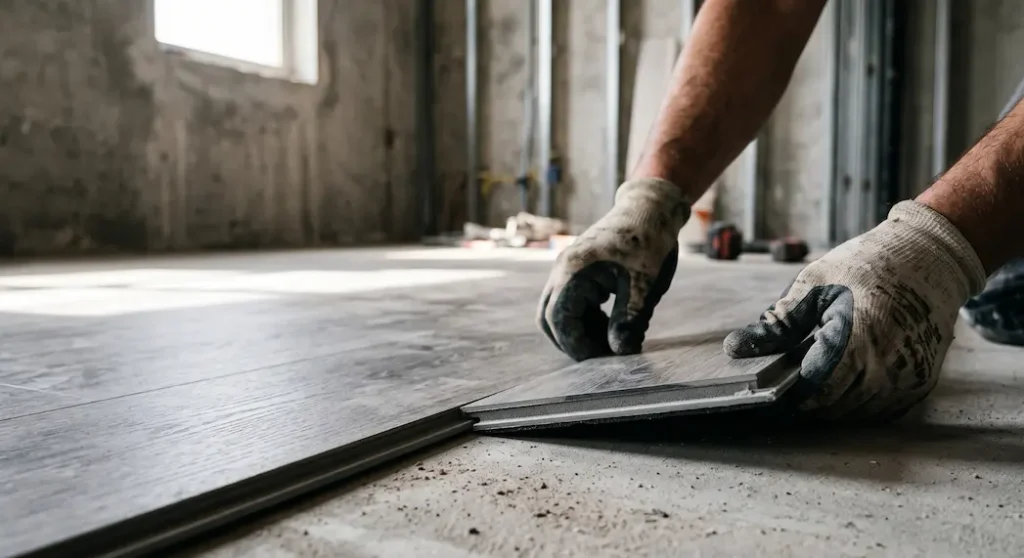
SPC is a rigid product. It does not bridge subfloor irregularities — it transmits them to the surface. An uneven subfloor creates high points in the installed floor where the rigid plank bears on the peak of a ridge rather than distributing load across its full surface area. These high points receive concentrated stress from foot traffic and rolling loads, and they wear significantly faster than the rest of the floor. In severe cases, the plank at a high point can crack or delaminate at the core long before the wear layer is consumed.
The standard tolerance for SPC subfloor preparation is no more than 3mm variation over a 1.8-metre span. Deviations beyond this require grinding or self-levelling compound before installation proceeds. This is non-negotiable — SPC simply does not perform as specified on an uneven subfloor, and any wear resistance figure in the product specification assumes a compliant installation.
Expansion Gaps and Their Role in Long-Term Floor Integrity
All floating floor systems — including SPC and laminate — require expansion gaps around the perimeter and at transitions to accommodate thermal movement. A floor installed without adequate expansion gaps leaves no room for the material to expand and contract as temperatures change. The result is internal stress that has nowhere to go — and the floor buckles upward. This is not a cosmetic issue. A buckled floor creates uneven surface points that concentrate wear, and the structural disruption to the locking system shortens the floor’s functional life significantly. Proper expansion gap planning is especially important in spaces with significant temperature variation — uninsulated retail units, ground-floor installations in cold climates, and spaces adjacent to loading areas.
Underlayment Selection and Its Effect on Wear Performance
Underlayment affects more than acoustic performance. A properly specified underlayment — typically 1mm to 2mm IXPE, EVA, or cork composite — provides a slight cushioning effect that reduces peak impact loads on the wear layer during heavy foot traffic and dropped objects. Without underlayment, or with underlayment that has compressed and lost its cushioning properties over time, the wear layer absorbs the full impact of each footfall directly, accelerating surface wear in high-traffic zones. Many SPC products include a pre-attached underlayment layer for precisely this reason — check the product specification before adding a second layer, as excessive underlayment thickness can destabilise the locking joint system.
How to Talk to a Supplier About Wear Resistance: The Questions That Actually Matter
When evaluating wear-resistant flooring suppliers, the questions you ask will determine the quality of the information you get. Generic claims of “excellent durability” or “commercial grade performance” are not specification data. Here are the specific questions that generate useful answers.
First, ask for the AC rating (for laminate) or wear layer thickness (for SPC) and the specific test standard it was measured against. EN 13329 for European markets and NALFA for North American markets are the relevant standards for laminate. For SPC, EN ISO 10582 covers the wear resistance test protocol. If a supplier cannot name the test standard, the rating has not been independently verified.
Second, ask whether the product carries FloorScore certification. FloorScore covers VOC emissions, but the certification process also requires that product specifications — including wear layer thickness — are verified against actual production samples. A product with FloorScore certification has had its wear layer thickness independently confirmed, which is a meaningful quality assurance step. For wood products, ask for FSC certification documentation to verify responsible sourcing claims.
Third, ask about the installation requirements for the product in your specific subfloor condition. A supplier who tells you SPC can go over any subfloor without qualification is either uninformed or optimistic. The correct answer involves subfloor flatness tolerance, moisture vapour transmission requirements for ground-floor installations, and the recommended underlayment specification. At Karlyn Floors, we have been working with specifiers, contractors, and buyers across commercial project types for over 30 years. Our office flooring guide and hotel flooring guide cover zone-by-zone specification in detail for the two most demanding commercial project types.
Common Mistakes in Wear-Resistant Flooring Specification
The errors that consistently produce underperforming floors are predictable and preventable. Understanding them is part of developing a competent specification process.
The most common mistake is specifying a residential product for a commercial project because the surface finish matches the design intent. Residential SPC and laminate use 0.3mm wear layers and lower-rated locking systems designed for domestic traffic loads. Putting them in a retail store or office produces floors that look worn within two to three years. The visual match is real; the performance match is not. Always verify the commercial rating before specifying.
The second most common mistake is ignoring rolling loads when selecting products. Most product specifications quote foot traffic performance because that is what the standard tests measure. Rolling load performance — castor chairs, luggage trolleys, wheeled equipment — is tested separately and less consistently across the industry. For an office environment, the castor chair wear scenario is far more damaging than foot traffic, and a product selected purely on AC rating without reference to its rolling load performance may fail at the surface despite meeting its AC specification. The CARB Phase II compliance of the product’s core is a separate quality metric that ensures formaldehyde emissions are controlled — verify this independently of the wear rating.
The third mistake is underspecifying for moisture. The combination of daily cleaning and atmospheric humidity in commercial buildings creates a moisture environment that standard laminate was not designed to handle. In any space that gets wet-mopped regularly — school corridors, restaurant service areas, hotel public areas — wear-resistant flooring needs a moisture-resistant core, not just a hard surface. This is why SPC is the appropriate specification for these zones rather than standard laminate, regardless of its AC rating.
Frequently Asked Questions
What is the most wear-resistant flooring for commercial use?
For the majority of commercial environments, SPC with a 0.5mm wear layer is the most practical and reliable choice. It combines strong surface abrasion resistance with a fully waterproof core, making it suitable for virtually every commercial scenario — from offices and retail stores to school corridors and restaurant floors. Teak solid wood offers exceptional long-term wear resistance with the added benefit of refinishing, but it is best suited to premium residential and high-end hospitality settings such as hotel suites and private villas, where the investment horizon is long and maintenance discipline is high. For standard commercial projects, SPC is the right answer.
What does AC rating mean for wear-resistant flooring?
AC rating stands for Abrasion Class, and it measures how many revolutions of a standardised abrasive wheel a laminate floor surface can withstand before the decorative layer is visibly worn through. AC1 and AC2 are for low to moderate residential traffic. AC3 covers heavy residential use and light commercial applications. AC4 is the minimum for general commercial specification — shops, cafés, and offices. AC5 covers heavy commercial use including department stores and public buildings. AC6 is reserved for very heavy commercial environments such as airport terminals. The rating applies specifically to surface abrasion and does not measure moisture resistance, structural integrity, or rolling load performance.
Is SPC or laminate more wear-resistant?
In dry, controlled environments, AC5 laminate and 0.5mm SPC deliver broadly comparable surface abrasion resistance. The meaningful difference is in moisture resistance: SPC’s waterproof core eliminates the joint swelling and structural failure that ends laminate floors prematurely in any space exposed to regular moisture. In consistently dry, climate-controlled interiors, high-density laminate like MoistureShield 1000 is a competitive and cost-effective wear-resistant flooring option. In moisture-exposed environments, SPC is the more reliable long-term specification because its failure mode is surface wear rather than structural damage.
How does foot traffic rating translate into years of service?
It does not translate directly, which is one of the honest limitations of wear ratings. AC ratings and wear layer thickness tell you the relative performance of products against each other under standardised test conditions — they do not convert directly into years of real-world service. Service life depends on traffic volume and type, maintenance quality, cleaning products used, subfloor preparation quality, and the project’s humidity environment. As a rough planning guide: AC4 laminate in a general commercial office typically delivers eight to twelve years. SPC with a 0.5mm wear layer in the same environment typically delivers ten to fifteen years. These ranges can shift significantly based on the factors listed above.
Does Karlyn Floors offer wear-resistant flooring with certified ratings?
Yes. Our SPC, laminate, and MoistureShield 1000 products carry verified certifications including ISO 9001, CE marking, and FloorScore for VOC compliance. Our wood products carry FSC certification. All products undergo rigorous physical property and formaldehyde emission testing, with SGS test reports available on request. Contact our team to request documentation or to discuss the right wear-resistant flooring specification for your project.
Conclusion: Specify for the Worst Day, Not the Average Day
The principle I keep coming back to across more than thirty years of commercial flooring projects is this: specify for the worst day your floor will face, not the average day. The average day in a hotel lobby is manageable. The worst day is a wet November weekend when three hundred guests check in within four hours, dragging luggage and muddy shoe soles across every square metre of your entrance floor. The floor you install needs to survive that day, repeatedly, for ten to fifteen years.
Wear-resistant flooring is not about the highest-rated product — it is about matching the right material to the specific combination of traffic intensity, moisture exposure, cleaning regime, and ownership horizon that defines your project. A teak floor in the wrong environment is not wear-resistant. An AC3 laminate in the right environment — a bedroom, a low-traffic residential space — is perfectly adequate wear resistance for the purpose.
Get the specification right, verify the ratings against the test standard that actually reflects your project’s wear conditions, confirm installation requirements before the floor goes down, and build in a maintenance protocol that preserves the surface from day one. Do those four things, and wear-resistant flooring lives up to its name. Skip any one of them, and even the most impressively rated product will disappoint you.
If you would like to discuss the right wear-resistant flooring specification for your project — whether that is a single hotel property, a school district, or a retail rollout across multiple locations — reach out to the Karlyn Floors team. We have been doing this for a long time, and we are happy to work through the numbers with you before you commit to a specification.