
Every flooring product brochure quotes a lifespan number. Thirty years. Twenty-five years. Lifetime warranty. These numbers are technically defensible under laboratory conditions and practically meaningless in a hotel corridor, a school cafeteria, or a rental apartment where the floor absorbs real-world abuse that no test protocol fully replicates.
Flooring lifespan is not a fixed property of the material. It is the result of the material interacting with a specific environment, a specific traffic pattern, a specific maintenance regime, and a specific definition of when “worn” becomes “unacceptable.” A teak floor in a low-traffic private residence might last sixty years. The same teak in a busy restaurant might need refinishing every five years and full replacement in twenty. Same material, completely different lifespan — because lifespan is not about the product. It is about the context.
This guide compares the realistic service life of every major flooring category across different use scenarios, breaks down what actually shortens a floor’s life, and introduces the metric that matters most for procurement decisions: cost per year.
Flooring Lifespan by Material: The Realistic Numbers
The table below summarises the expected service life of each flooring type across three usage scenarios. These numbers are based on properly installed products with appropriate maintenance — not best-case laboratory estimates or worst-case neglect scenarios.
| Material | Low-Traffic Residential | Commercial Office / Retail | Heavy-Traffic (Hotel Corridor, School) | Refinishing Possible |
|---|---|---|---|---|
| Teak Solid Wood | 40–60 years | 25–35 years | 15–25 years | Yes — 3 to 4 times |
| Engineered Wood (3mm+ veneer) | 25–35 years | 15–25 years | 10–15 years | Yes — 1 to 2 times |
| SPC | 15–25 years | 10–15 years | 7–12 years | No |
| High-Density Laminate (1000 kg/m³) | 12–20 years | 8–12 years | 5–8 years | No |
| Standard Laminate (600–800 kg/m³) | 10–15 years | 5–10 years | 3–5 years | No |
A few things to notice. The gap between residential and heavy-traffic commercial lifespan is typically 50 to 70 percent — meaning a floor that lasts twenty years in a private home might last only eight years in a school corridor. Refinishing capability is the single biggest differentiator in lifecycle cost: materials that can be sanded and refinished effectively reset their wear clock without the cost and disruption of full replacement. Materials that cannot be refinished have a hard expiration date.
Teak Solid Wood: The Longest-Lasting Floor You Can Buy
Teak’s combination of natural oil content, dimensional stability, and hardness gives it the longest realistic service life of any flooring material. In a low-traffic residential setting with proper maintenance, a solid teak floor can last forty to sixty years — often outliving the building’s other interior finishes by decades. The ability to refinish three to four times over its service life means the surface can be restored to near-original condition multiple times before the plank thickness is consumed. Our teak flooring guide covers the material properties that drive this performance in detail.
In commercial settings, teak’s lifespan shortens but remains exceptional. A boutique hotel lobby with teak flooring typically runs fifteen to twenty years before the first refinishing cycle, and the total service life with two refinishing cycles can reach thirty years or more. The premium price per square metre is the obvious trade-off, but when calculated on a cost-per-year basis, teak frequently outperforms materials that cost half as much upfront but need replacement twice as often.
Engineered Wood: Premium Aesthetics with a Defined Lifespan
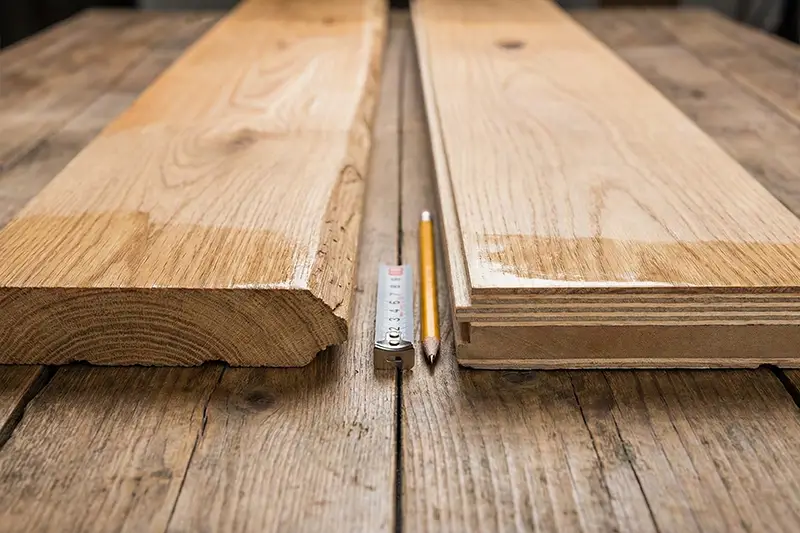
Engineered wood flooring delivers the visual and tactile experience of real hardwood with better dimensional stability, but its flooring lifespan is ultimately limited by the veneer thickness. A 3mm veneer allows one to two careful refinishing cycles. A 2mm veneer is essentially a single-use surface — refinishing risks sanding through to the core. This is why veneer thickness is the single most important specification detail when evaluating engineered wood for long-term commercial use.
In residential settings, engineered wood typically delivers twenty-five to thirty-five years of service with one refinishing cycle at the midpoint. Commercial offices and retail environments shorten this to fifteen to twenty-five years through the combination of foot traffic, rolling chair damage, and cleaning chemical exposure. In heavy-traffic zones like hotel corridors or school classrooms, ten to fifteen years is a realistic expectation. For a detailed comparison with solid wood, see our solid wood vs engineered wood guide.
SPC: The Performance Middle Ground
SPC flooring cannot be refinished — when the wear layer is consumed, the floor is done. But what SPC lacks in longevity it compensates for in consistency: the stone-plastic composite core does not absorb moisture, does not expand or contract with humidity changes, and does not deteriorate under the chemical cleaning agents that shorten the life of wood and HDF-based products. This makes SPC’s flooring lifespan remarkably predictable compared to materials whose longevity depends heavily on environmental control.
In residential settings with moderate traffic, SPC typically delivers fifteen to twenty-five years. Commercial environments bring that down to ten to fifteen years. In heavy-traffic zones — hotel corridors, retail stores, school cafeterias — seven to twelve years is realistic. The click-lock installation system also allows individual damaged planks to be replaced without re-flooring the entire area, which effectively extends the functional lifespan of the floor system even as individual planks reach their wear limit. Our SPC flooring range includes products with 0.3mm and 0.5mm wear layers — the thicker wear layer adds two to four years of service life in commercial applications.
Laminate: Budget-Friendly with a Hard Ceiling
Standard laminate at 600 to 800 kg/m³ density is the most affordable hard flooring option, but its lifespan ceiling is the lowest in this comparison. The melamine wear layer provides excellent scratch resistance while it lasts, but once consumed it cannot be restored. The HDF core is vulnerable to moisture at the joints, and accumulated moisture damage is the most common cause of premature laminate failure — ahead of surface wear in many environments.
Our MoistureShield 1000 at 1000 kg/m³ density extends laminate’s viable service life by two to five years in moisture-prone environments by dramatically reducing core absorption rates. In consistently dry, climate-controlled interiors, the difference is smaller. But in kitchens, ground-floor installations, and humid climate projects, the density upgrade can mean the difference between a floor that lasts five years and one that lasts ten. For a full comparison, see our moisture resistant laminate flooring guide.
What Actually Shortens Flooring Lifespan
Understanding why floors fail is as important as knowing how long they should last. The same material can deliver dramatically different service lives depending on three controllable factors.
Traffic Volume and Type
Foot traffic is the most obvious wear driver, but it is not the most destructive. Rolling loads — office chair castors, luggage wheels, cleaning equipment — concentrate force on small contact points and generate abrasion rates that far exceed foot traffic per unit of time. The ISO 4918 castor chair test was developed specifically to measure this type of wear, and the results consistently show that rolling loads cause surface degradation three to five times faster than equivalent foot traffic hours. A single office workstation with hard nylon castors generates more surface wear per year than a residential hallway serving a family of four. Our office flooring guide covers the rolling chair problem in detail, including the $3 to $5 per chair castor upgrade that can extend floor life by years.
Moisture and Climate
Moisture is the primary killer of HDF-based flooring products. Standard laminate installed in a kitchen without adequate spill management will show edge swelling within twelve to eighteen months. The same product in a consistently air-conditioned living room might last fifteen years without any moisture-related issues. SPC is immune to this variable, which is one reason its service life is more predictable across different environments. Wood products fall between these extremes — teak’s natural oil content provides substantial moisture resistance, while other hardwood species are significantly more vulnerable.
Maintenance Practices
The gap between “properly maintained” and “neglected” is typically three to seven years of service life across all material categories. Proper maintenance is not complicated: regular dust and grit removal to prevent abrasive particle damage, prompt spill cleanup on all HDF and wood products, pH-neutral cleaners rather than alkaline commercial products on wood surfaces, and periodic refinishing of solid and engineered wood floors before wear reaches the point of no return. Products certified under the NALFA certification program include specific maintenance guidelines validated through laboratory testing, which provides a useful starting point for developing a maintenance protocol.
The most common maintenance failure is not neglect but ignorance — using the wrong cleaning product, skipping the grit removal step, or delaying refinishing until the veneer is too thin to sand. For wood products sourced from FSC-certified forests, proper maintenance also extends the sustainability value of the material by maximising the service years extracted from each harvested tree.
The Refinishing Factor: Why It Changes Flooring Lifespan Economics

The ability to refinish a floor is the single most important variable in flooring lifespan economics. A solid teak floor that gets refinished three times over its service life effectively gets four separate wear cycles from one installation. Each refinishing costs a fraction of full replacement — typically 20 to 30 percent of the original installed cost — and causes far less disruption than ripping out and replacing the entire floor.
| Material | Refinishing Cycles | Refinish Cost vs Full Replacement | Effective Total Lifespan with Refinishing |
|---|---|---|---|
| Teak Solid Wood (18mm+) | 3–4 | 20–30% of replacement cost | 40–60 years |
| Engineered Wood (3mm+ veneer) | 1–2 | 25–35% of replacement cost | 25–35 years |
| Engineered Wood (2mm veneer) | 0–1 (risky) | Not recommended | 15–20 years |
| SPC | 0 | N/A — full replacement only | Equal to initial lifespan |
| Laminate (standard or high-density) | 0 | N/A — full replacement only | Equal to initial lifespan |
This table explains why a teak floor at $80 per square metre can be a better financial decision than a laminate floor at $25 per square metre over a thirty-year ownership period — the teak gets refinished twice during that period while the laminate gets fully replaced twice, and the total cost often favours the teak when installation labour and downtime costs are included.
Cost Per Year: The Metric That Actually Matters

The flooring industry’s fixation on cost per square metre is one of its most persistent blind spots. A floor’s true cost is its total installed cost — including material, underlay, installation labour, and anticipated maintenance — divided by its realistic service life in years. This cost-per-year metric transforms the comparison between materials in ways that upfront pricing alone cannot reveal.
| Material | Installed Cost (USD/m²) | Realistic Commercial Lifespan | Refinishing Cost Over Life | Approximate Cost Per Year (USD/m²) |
|---|---|---|---|---|
| Teak Solid Wood | $90–$140 | 25–35 years | +$40–$60 (2 refinish cycles) | $4.00–$5.70 |
| Engineered Wood | $60–$110 | 15–25 years | +$20–$35 (1 refinish cycle) | $4.00–$5.80 |
| SPC | $40–$70 | 10–15 years | None | $3.50–$5.80 |
| High-Density Laminate | $35–$55 | 8–12 years | None | $3.50–$5.50 |
| Standard Laminate | $25–$45 | 5–10 years | None | $3.50–$6.00 |
The numbers converge. When calculated on a cost-per-year basis, the gap between the most expensive and least expensive flooring lifespan options narrows dramatically. Teak at $4 to $5.70 per square metre per year is in the same range as standard laminate at $3.50 to $6.00 — because the laminate needs replacement two to three times during the same period that teak needs only refinishing. The difference is that teak involves higher upfront capital and lower ongoing disruption, while laminate involves lower upfront capital and higher replacement frequency. The right choice depends on the ownership horizon and how much operational disruption the project can tolerate.
How to Choose Based on Your Project’s Ownership Horizon
The ownership horizon — how long the current owner or tenant plans to use the space — is the single most useful framework for translating flooring lifespan data into a material decision.
For short-term ownership of five years or less — rental apartments, retail tenancies, startup offices — standard laminate or SPC delivers the best return. The floor will be replaced at the next tenant changeover regardless of its remaining wear life, so investing in a material with a thirty-year lifespan is paying for durability that will never be used. Our engineered wood vs laminate guide discusses this dynamic in the context of rental property specification.
For medium-term ownership of five to fifteen years — owner-occupied commercial spaces, branded hotel properties, corporate offices — SPC or engineered wood provides the best balance of performance and lifecycle cost. The floor needs to maintain its appearance through at least one but probably not two full renovation cycles, and the material’s mid-range lifespan aligns with the ownership period. Our hotel flooring guide and office flooring guide cover zone-by-zone specification for these project types.
For long-term ownership of fifteen years or more — owner-occupied residences, heritage properties, institutional buildings — teak or premium engineered wood with a thick veneer delivers the lowest total cost of ownership. The ability to refinish extends the floor’s life across multiple decades, and the aesthetic improvement that comes with natural wood aging adds value that depreciating synthetic materials cannot match.
Frequently Asked Questions
Which flooring lasts the longest?
Teak solid wood, with a realistic service life of forty to sixty years in residential settings and twenty-five to thirty-five years in commercial use, including three to four refinishing cycles. No other commercially available flooring material matches this combination of durability, refinishing potential, and natural resistance to moisture and pests. However, its high upfront cost means it is only the most cost-effective choice when the ownership horizon is long enough to realise the lifecycle savings.
Does SPC flooring last longer than laminate?
Yes, in most environments. SPC’s waterproof core eliminates the moisture-related failures that are the leading cause of premature laminate degradation. In a dry, controlled environment, the difference is modest — perhaps two to five years. In moisture-prone environments like kitchens, basements, or humid climates, SPC can outlast standard laminate by five to ten years because the HDF core in laminate swells irreversibly when moisture penetrates the joints.
Is it worth paying more for a longer-lasting floor?
It depends on how long you plan to own the space. For a five-year rental property, no — a ten-year floor and a thirty-year floor both get replaced at tenant changeover. For a twenty-year owner-occupied commercial space, yes — a material that needs one refinishing instead of two full replacements will save money over the ownership period, even though it costs more upfront. The cost-per-year calculation in this guide provides the framework for making that decision with actual numbers.
How does maintenance affect flooring lifespan?
Proper maintenance typically adds three to seven years of service life across all material categories compared to neglected floors. The highest-impact maintenance practices are regular grit removal (prevents abrasive particle damage), prompt spill cleanup on HDF and wood products, using pH-neutral cleaners on wood surfaces, and timely refinishing of solid and engineered wood before the veneer is too thin to sand. The most common failure is not neglect but using the wrong cleaning products — alkaline or ammonia-based cleaners strip natural oils from wood surfaces and accelerate wear.
Does Karlyn Floors offer products across all lifespan categories?
Yes. Our range spans from standard laminate for short-cycle rental specification through to Burmese teak for multi-decade luxury installations, with SPC, high-density laminate, and engineered wood covering everything in between. Every product comes with verified certifications including CE, ISO 9001, and FloorScore, along with full origin documentation. Products with HDF cores comply with CARB Phase II emission standards. Contact our team for lifecycle cost analysis and specification support matched to your project’s ownership horizon.
Conclusion: Buy the Lifespan You Need, Not the Lifespan That Sounds Best
The most expensive mistake in flooring lifespan planning is not buying a floor that wears out too soon. It is buying a floor that lasts thirty years for a space you will occupy for five — or buying a floor that lasts five years for a space you will own for thirty. Both scenarios waste money. The first wastes it on durability that never gets used. The second wastes it on repeated replacement cycles that a better initial specification would have avoided.
The cost-per-year metric strips away the marketing noise and reduces the comparison to a single question: what does this floor cost me for each year it performs? When you run those numbers, the gap between premium and budget materials is far smaller than the price tags suggest. What differs is the pattern of spending — high upfront with low ongoing, or low upfront with high recurring. Match that pattern to your ownership horizon, and the right material chooses itself.